
You publish a strong page. The keyword targeting is right. The on-page work is clean. The page loads fast, reads well, and still sits below weaker competitors.
That's the moment organizations often start asking what is link building, usually because they've hit the limit of what content and technical SEO can do on their own. Search engines don't just evaluate the page itself. They also evaluate who on the web is willing to reference it.
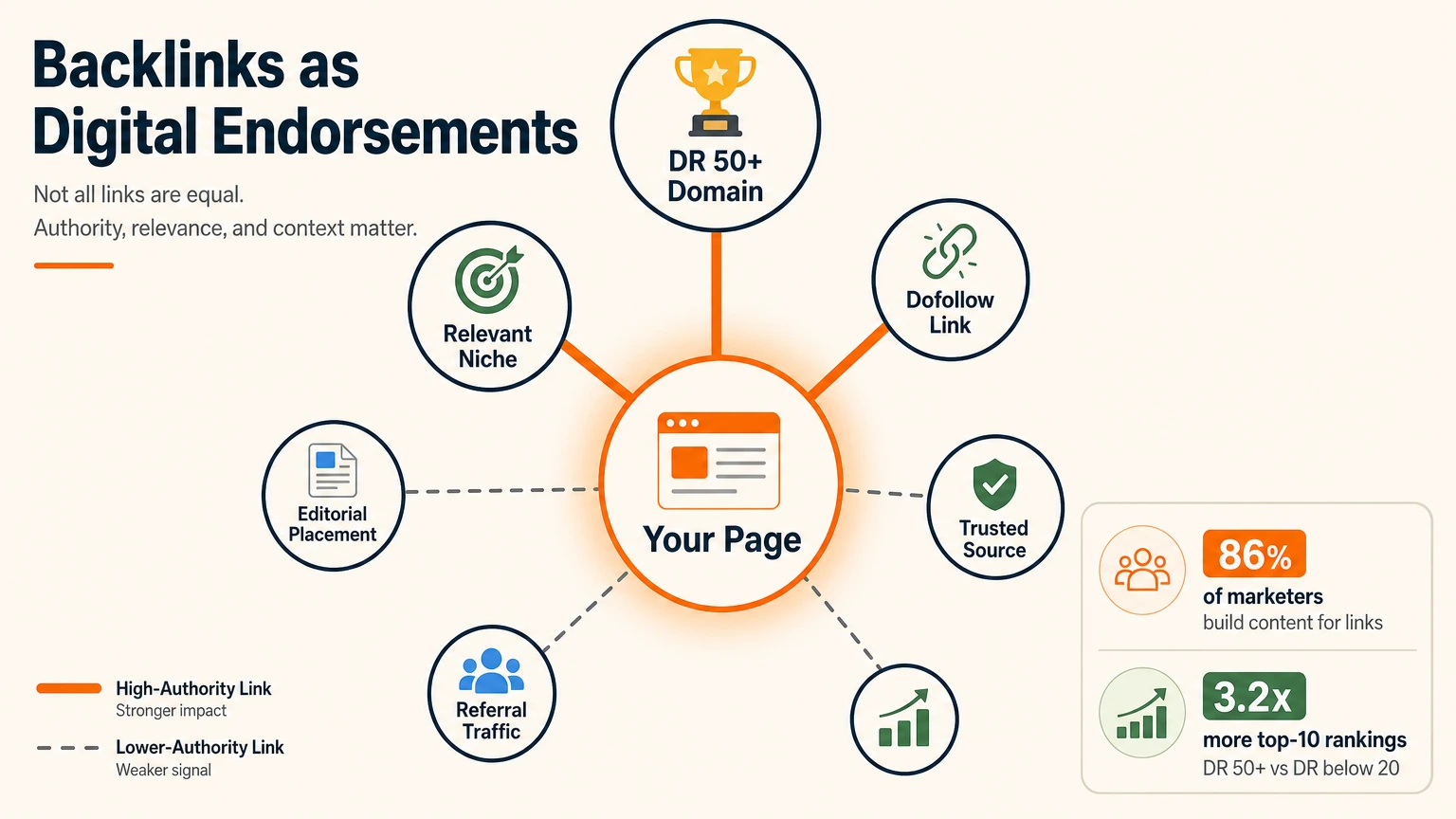
The beginner mistake is to think link building means “go get as many links as possible.” The professional view is different. Link building is the process of earning or securing relevant backlinks that strengthen authority, support rankings, and hold up over time. The last part matters more than most guides admit. A backlink that disappears, flips to nofollow, or gets buried on a junk page stops being an asset and starts becoming wasted budget.
What Is Link Building and Why Does It Still Matter
Link building is the practice of getting other websites to link to pages on your site. In search, those links act like third-party endorsements. They don't guarantee rankings, but they help search engines judge whether your content deserves trust.
That's why a page can be excellent and still underperform. If competing pages have stronger backlink profiles, Google has more external signals telling it those pages are established and credible. Good content matters. Technical health matters. But authority still has to be earned.
The market behavior around SEO makes that obvious. 86% of marketers create content specifically to generate backlinks, and over a quarter of total SEO budget goes directly to link-building activities according to Ahrefs' link building research. Teams don't allocate that much time and budget to an optional tactic.
A simple way to think about it is this:
Content proves usefulness: Your page answers the query.
Links prove recognition: Other sites are willing to reference that answer.
Consistency proves trust: Those references stay live and relevant long enough to matter.
If you're still getting oriented, this guide to building backlinks gives a practical overview of the common approaches and where each one fits.
Practical rule: Link building matters most when your site already has pages worth ranking, but not enough authority to win against established competitors.
This is also why link building isn't just an outreach task. It sits at the intersection of content strategy, relationship building, and risk control. A junior team member often sees a backlink as a one-time win. A seasoned SEO lead sees a portfolio of placements that need to be selected carefully, tracked, and protected.
How Backlinks Actually Influence Search Rankings
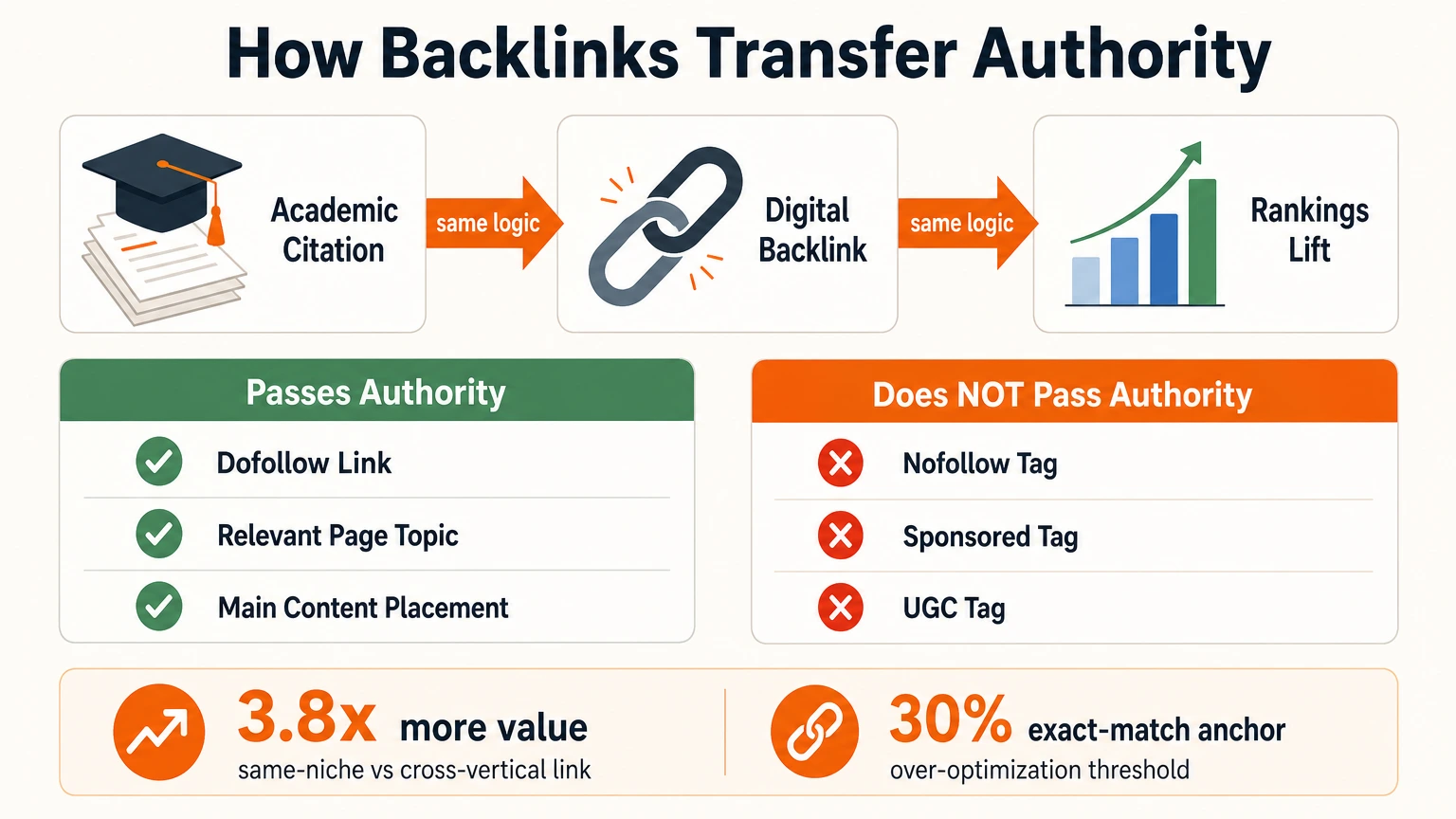
Backlinks work a lot like academic citations. If a respected paper cites your research, that citation tells readers your work is worth attention. Search engines interpret backlinks in a similar way. When a credible site links to your page, it passes a measure of authority and context.
Authority transfer is not equal across all links
Not every backlink carries the same weight. The source site matters, the source page matters, and the link attributes matter.
A dofollow link transfers ranking potential. By contrast, sponsored and ugc tags explicitly prevent that transfer. The same research also notes that pages with a Domain Rating of 50+ rank 3.2x more frequently in the top 10 for commercial keywords than pages with a DR below 20, which is why SEOs pay so much attention to authority metrics when evaluating prospects, as covered in Backlinko's ranking factors analysis.
A good backlink usually combines several useful signals:
| Signal | What it means in practice |
|---|---|
| Authority | The linking domain and page are trusted enough to pass value |
| Relevance | The page topic aligns with the topic of your page |
| Placement | The link sits naturally in the main content, not in cluttered side areas |
| Crawlability | Search engines can access and process the page and link |
Link attributes change the outcome
A lot of confusion comes from treating every visible link as an SEO win. It isn't.
Dofollow links: These are the placements typically sought for ranking impact.
Nofollow links: These can still send referral traffic or brand exposure, but they aren't the same as equity-passing placements.
Sponsored links: These explicitly signal a paid relationship.
UGC links: These identify user-generated content, such as forum posts or comments.
That difference is one reason you can't judge success by screenshots alone. You need to confirm what attribute was delivered.
Later in the buying process, it also helps to see the mechanics visually:
Why rankings don't move from random links
A weak tactic is to chase any site willing to place a link. That usually creates noise, not authority. Search engines look for meaningful signals, not just volume. A contextual link from a relevant article can do more than a pile of low-quality placements on unrelated blogs.
Treat backlinks like references on a resume. A credible recommendation from the right person carries more weight than a long list of irrelevant names.
That's the answer to what is link building in ranking terms. It's not collecting URLs. It's acquiring endorsements that search engines can interpret as credible, relevant, and worth counting.
Exploring the Most Common Link Building Tactics
Once you understand how backlinks affect rankings, the next question is how teams get them. In practice, most link building programs rely on a handful of repeatable tactics. They differ in speed, cost, control, and risk.
Guest posting
Guest posting means writing an article for another website and earning a backlink inside that article or author area. It's still one of the most common methods because it gives you control over topic fit and link context.
The trade-off is speed. You need a pitch, an approved topic, a draft, edits, and publication. It also costs more than many teams expect. Guest posting is used by 64.9% of link builders and costs around $295 per placement on average, according to Ahrefs' link building stats.
Guest posts tend to work well when:
You need topical control: You can shape the article around a relevant subject.
You're building thought leadership: A bylined article can support brand credibility as well as SEO.
You can write to editorial standards: Thin, obvious SEO copy usually won't hold up.
Link insertions and niche edits
A link insertion, often called a niche edit, places your link into an existing published article. This is often more efficient than creating a new post because the page may already have authority, internal links, and rankings.
It's also cheaper in many cases. The same Ahrefs data puts the average link insertion at about $104, which is far below average guest post pricing. In practical terms, that makes niche edits attractive when you need faster deployment and stronger page-level context.
They work best when the existing article already covers the exact subject your target page supports. They work poorly when the link feels forced or when the page is clearly overloaded with outbound placements.
Digital PR and foundational links
Digital PR sits on the other end of the spectrum. It aims to earn editorial links through stories, data, commentary, or newsworthy assets. When it works, the links are hard to replicate and often appear on strong publications. The downside is unpredictability. You can do solid campaign work and still get little coverage.
Foundational links are simpler. These include business profiles, directories, association pages, citations, and other baseline references. They usually won't carry the same authority as editorial placements, but they help establish legitimacy and round out a backlink profile.
A quick comparison
TacticBest use caseMain upsideMain downsideGuest postBuilding authority in a controlled topicStrong context and editorial controlSlower and more expensiveNiche editSecuring relevant links on existing pagesFaster, often lower costEasy to overdo on low-quality sitesDigital PREarning high-trust editorial mentionsStrong authority potentialLess predictableFoundational linksEstablishing baseline trust signalsEasy to secureLimited ranking impact on their own
For resource-focused outreach, a targeted resource page link building approach can also be useful when your content deserves inclusion on curated lists.
One note on strategy choice. A lot of teams still default to guest posts because they're familiar. That's not always the right move. If you're evaluating content-led outreach, the Skyscraper SEO technique is worth understanding, especially because it highlights how “better content” alone doesn't guarantee links unless the outreach and page fit are right.
How to Evaluate Link Quality and Spot Red Flags
The fastest way to waste link-building budget is to buy placements that look fine in a spreadsheet but fail under inspection. Good links help rankings. Bad links create clutter, distort your anchor profile, and can put your site too close to spam.
A strong evaluation process starts with a basic question. If you removed the SEO incentive, would this site still look like a real publication or business?
The three signals that matter most
When I vet placements, I care most about relevance, page context, and whether the site appears to have real editorial standards.
Relevance comes first. A technically strong domain in the wrong niche is still the wrong placement. A link from a page within the same niche transfers 3.8x more ranking value than a cross-vertical link, based on the technical data referenced by Moz's link-building material.
Context comes next. The link should sit naturally inside the main body of a page that thoroughly discusses the topic. A buried link in a generic paragraph added only for SEO is usually weak, even if the domain metrics look decent.
Editorial integrity is the filter. If every article on the site reads like outsourced filler and each post links to unrelated industries, the domain is telling you exactly what it is.
Anchor text is where teams get reckless
Anchor text still matters, but teams overplay it. They want exact-match anchors because they think that's how rankings move fastest. Sometimes they do. The problem is that aggressive anchor text leaves a pattern.
The same technical reference notes that over-optimization becomes risky when more than 30% of anchors are exact-match. That doesn't mean exact-match anchors are off-limits. It means they need to be used sparingly inside a broader, natural profile that includes branded, partial-match, and generic anchors.
A safe anchor profile looks a little messy. A dangerous one looks engineered.
Red flags that should stop the order
Some warning signs are obvious once you know what to scan for:
Unrelated outbound links: A blog post about HR software suddenly linking to casinos, crypto, and payday loans is a bad sign.
Thin content: If most pages exist only to host outbound links, don't expect lasting value.
Template footprints: Repeated article structures, identical author boxes, and unnatural publication patterns often signal network behavior.
Forced placement language: If the sentence doesn't read naturally without your link, the edit was probably made for the wrong reason.
Weak indexing or visibility signals: If the site looks abandoned or invisible in search, the placement may never matter.
A practical review checklist
Before approving a placement, run through this short checklist:
Read the page itself: Don't approve from metrics alone.
Check topical fit: The page topic should clearly overlap with your target page.
Review nearby outbound links: They tell you what kind of inventory the site is selling.
Assess the anchor text: Make sure it helps the sentence, not just the keyword target.
Check whether the site looks maintained: Freshness, structure, and editorial consistency matter.
A common point of failure for amateur link building emerges. The amateur asks, “Can I get a link here?” The professional asks, “Should I want this link attached to my brand and backlink profile six months from now?”
Building an Efficient Link Building Workflow
Link building gets chaotic fast when every order lives in a separate spreadsheet, every prospect gets vetted manually, and nobody owns post-publication checks. Good teams turn it into an operational system.
The cleanest workflow has five stages: prospecting, vetting, ordering, placement, and monitoring. Each stage needs a clear owner and a standard for what “done” looks like.
Stage one through three
Prospecting is where you build your target list. Some teams prospect through search results, competitor backlink reviews, or outreach databases. Others use publisher marketplaces to skip the cold-start problem.
Vetting involves significant SEO judgment. Here, you confirm niche fit, page quality, traffic signals, and outbound link patterns. If this stage is weak, the rest of the process won't save you.
Ordering should be simple and documented. The brief needs to specify target URL, anchor text, preferred page context, and any exclusions. If your team manages multiple clients, it also needs conflict controls so the same domain doesn't get reused carelessly.
Placement and verification
Once a link goes live, don't mark it complete until someone checks the actual page.
That review should confirm:
Correct destination URL: No broken or redirected target unless approved
Correct anchor text: Matches the brief or approved variation
Correct attribute: Dofollow, nofollow, sponsored, or UGC as agreed
Reasonable placement: Main content, relevant paragraph, natural sentence flow
This is also where tooling starts to matter. Some teams still manage this manually in Google Sheets and browser tabs. That works at low volume, but it gets brittle fast. A platform such as PRWiz can centralize publisher discovery, ordering, and monitoring in one place, and its marketplace structure is built around transparent domain review rather than blind package buying. For teams that still rely on manual outreach, a dedicated blogger outreach service can also fit into this workflow when curated marketplace inventory doesn't cover the niche.
Monitoring is not optional
Most beginner workflows stop at “link placed.” That's not enough.
A backlink is only useful while it stays live, indexable, and configured the way you paid for or earned. If a publisher later removes it, changes the rel attribute, or lets the page decay, the asset has changed. Your workflow should treat that as an operational event, not a surprise.
Workflow rule: A placed link is pending until it has passed post-publication QA. After that, it becomes a monitored asset.
The teams that scale link building well are rarely doing anything mysterious. They just reduce randomness. They standardize selection, tighten approvals, verify every delivery, and maintain records that let them defend the budget when someone asks what the links produced.
Managing Risk and Measuring Link Building Success
The part most guides skip is what happens after the link goes live. That's where a lot of value leaks out.
A paid or negotiated placement can vanish unnoticed. An editor updates an article. A site changes policy. A link gets converted to nofollow. If nobody's watching, you may keep reporting the backlink as an asset long after it stopped helping.
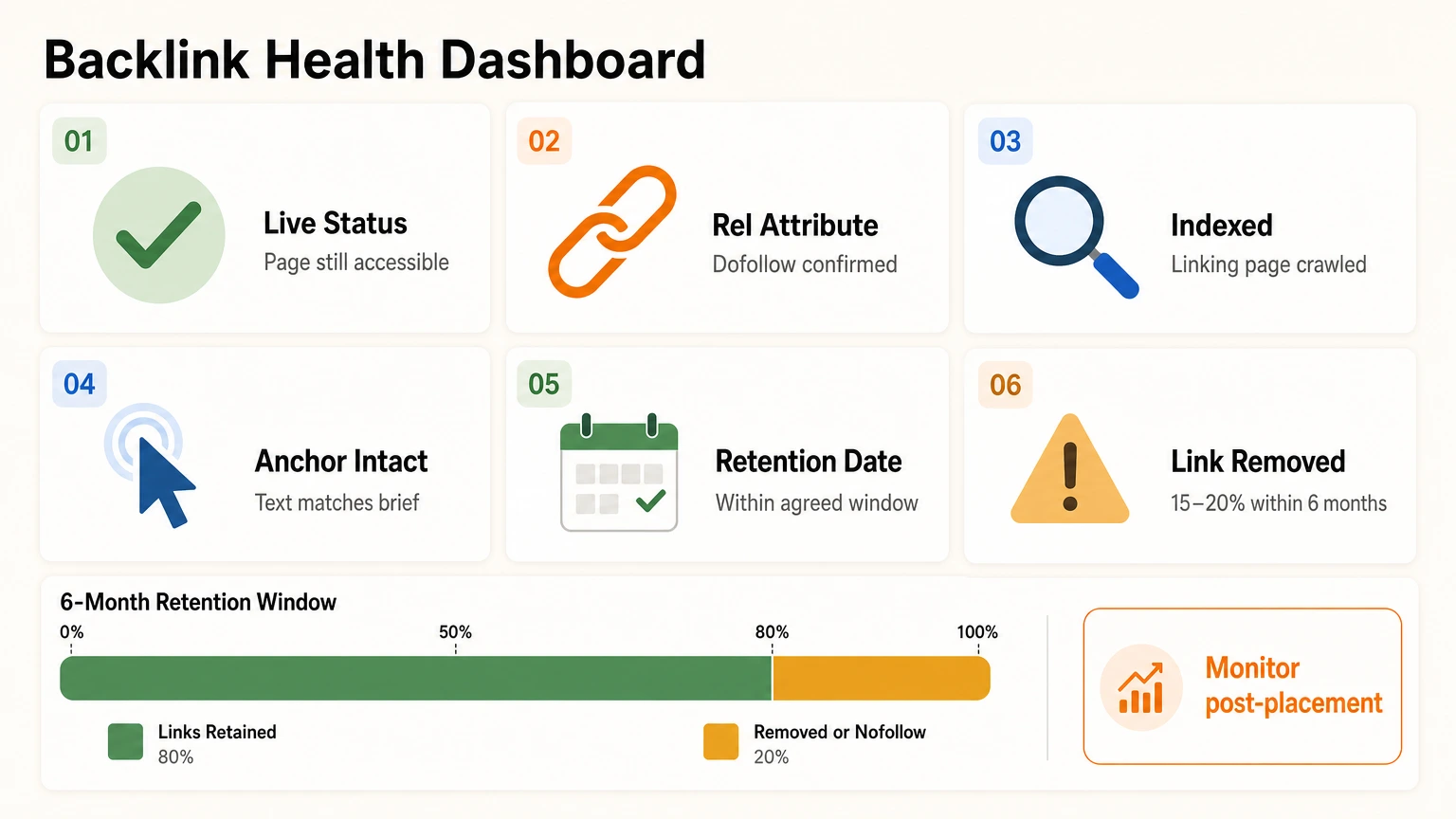
The validity window problem
The idea of a validity window becomes useful. A placement shouldn't be treated as permanent by default. It should be treated as an asset with a retention expectation.
According to the benchmark cited by Search Engine Journal's technical link building guide, 15-20% of purchased guest post links are removed or converted to nofollow within 6 months. That's a big enough failure rate that every serious team should build monitoring into the process.
What to track after placement
You don't need a huge analytics framework to manage link risk well. You do need the right checks.
Live status: Is the page still up and accessible?
Rel attribute: Did the link remain dofollow or change?
Indexation: Is the linking page still indexed?
Anchor and target integrity: Did the publisher alter the text or destination?
Retention date: Has the placement stayed live through the agreed period?
For ongoing control, a backlink monitor feature is useful because it turns silent degradation into something visible your team can act on.
Measuring whether link building is working
A single link rarely tells the whole story, so success measurement needs a portfolio view. The cleanest indicators are movement in rankings for target pages, improvement in overall organic visibility, and referral traffic from the placements themselves.
There's also a qualitative layer that experienced teams watch closely. Are new pages ranking faster than they used to? Are commercial pages getting enough authority to compete? Are link targets holding their positions more consistently?
Don't evaluate link building only by acquisition volume. Evaluate whether the pages you support become harder for competitors to displace.
That's the professional shift. Link building success isn't just about getting links. It's about acquiring links that remain live, stay relevant, and contribute to durable search performance.
Your Next Steps in Effective Link Building
If you're still asking what is link building, the shortest useful answer is this. It's the process of building a reliable portfolio of external endorsements that search engines can trust.
The part beginners miss is that acquisition is only half the job. You need relevant placements, sensible anchor choices, clear workflow standards, and a way to keep links from disappearing without notice. That's what separates a few random wins from a program you can scale.
Start with pages that already deserve to rank. Build links to assets with clear commercial or strategic value. Prioritize relevance over volume. Approve placements manually until your quality standards are tight. Then make monitoring part of the system, not an afterthought.
That approach won't feel flashy, but it's the one that holds up. Good link building is disciplined, selective, and accountable.
If you want one place to handle sourcing, ordering, and retention tracking, PRWiz is built for that workflow. It combines a curated publisher marketplace with daily backlink monitoring, which makes it useful for teams that care as much about keeping links live as they do about getting them placed.