
Every few months a panicked buyer forwards me a spreadsheet. It is a backlink audit from some tool, hundreds of rows glowing red, each one stamped with a "toxicity score." Their rankings dropped, the tool blamed toxic backlinks, and now they want to disavow the lot.
I run an AI-first link building marketplace, so I see this fear from both sides. Here is the uncomfortable truth: in almost every one of those spreadsheets, the links were never the problem, and disavowing them would have done nothing, or made things worse.
Toxic backlinks are low-quality or manipulative links a tool flags as harmful. Most are spam Google already ignores. Only links you built to manipulate rankings, or ones tied to a manual action, are worth removing or disavowing.
That does not mean bad links are a myth. It means the label gets slapped on the wrong things, and the fix gets applied when it should not be. Let me untangle it.
Key takeaways
- Toxic backlinks are mostly a tool invention: Google's John Mueller has said plainly that toxic is a term made up by SEO tools, not a signal Google uses.
- Google ignores most spam automatically: since Penguin 4.0 in 2016, its systems devalue low-quality links rather than penalize your whole site.
- Patterns hurt, single links do not: what harms rankings is a profile full of links you built or bought to manipulate, not the odd scraper link.
- The disavow tool is a loaded gun: Google says most sites never need it, and using it wrong can strip links that were actually helping you.
- There are only two real reasons to disavow: a manual action for unnatural links, or a large volume of manipulation you created yourself and cannot remove.
- Negative SEO rarely works: Google's Gary Illyes says he has never found it to be the true cause of a traffic drop, so investigate other causes first.
- Prevention beats cleanup: buy and build from vetted sites and keep junk domains out of your workflow, so a toxic profile never forms in the first place.
None of what follows is guesswork. It comes from Google's own documentation and public statements, plus what I watch happen in real link profiles every week.
What are toxic backlinks, really?
A toxic backlink is any inbound link an SEO tool decides could hurt your rankings, based on its own scoring. The catch is that "toxic" is the tool's word, not Google's. Google never adopted the concept.
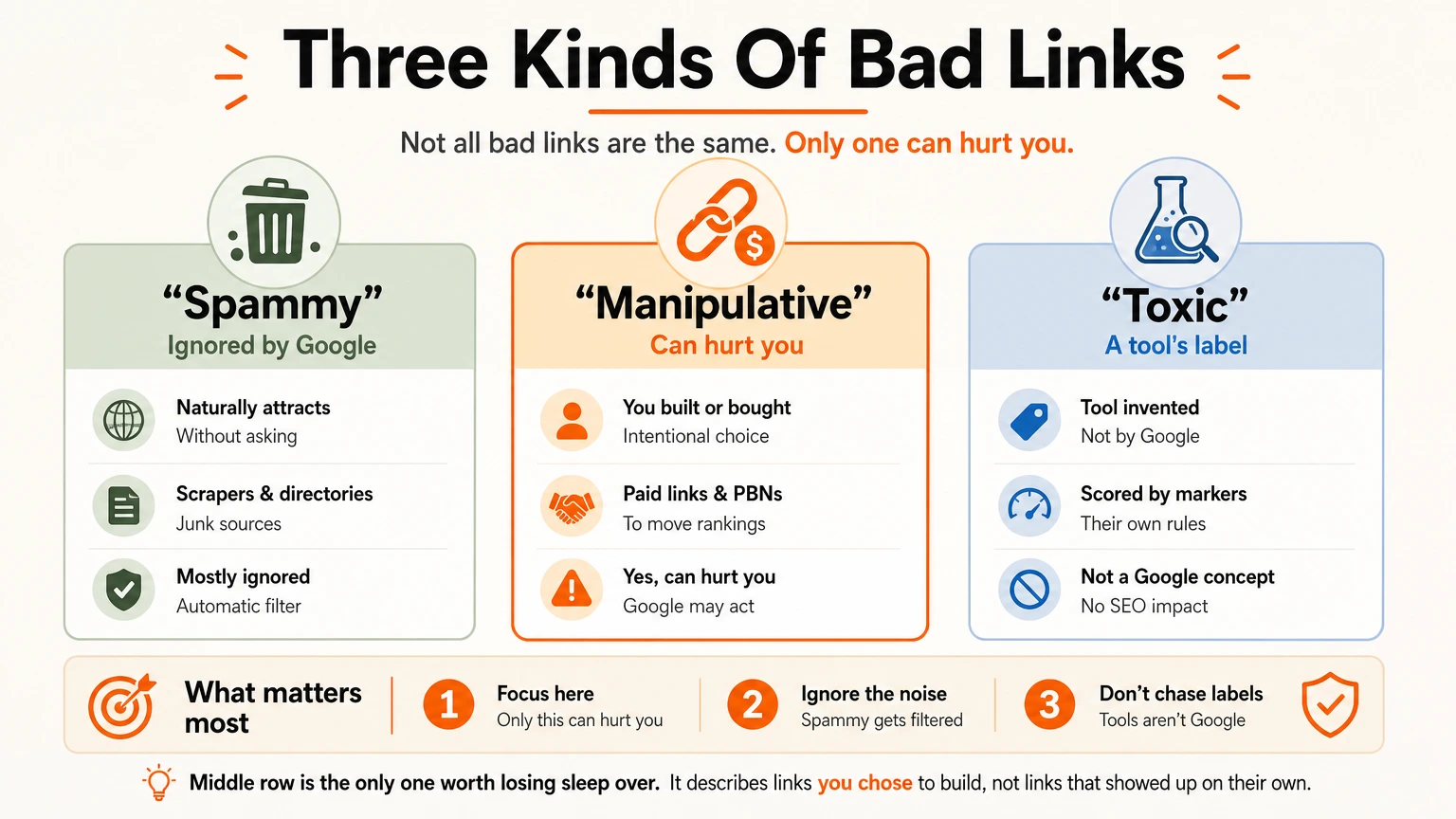
The clearest way to think about it is to separate three things people mash together. Once you split them, the whole panic gets smaller.
Term | What it means | Does Google care? |
|---|---|---|
Spammy links | Low-quality links any site attracts without asking, from scrapers and junk directories | Mostly ignored automatically |
Manipulative links | Links you built or bought to move rankings, like paid links or PBNs | Yes, these can hurt you |
"Toxic" links | A label invented by SEO tools, scored by their own markers | Not a Google concept |
Read down that last column and the point lands. The middle row is the only one worth losing sleep over, and it describes links you chose to build, not links that showed up on their own.
What makes a backlink toxic?
If we use the label the way it is meant, a link is genuinely risky when it looks built to game Google. The markers that actually matter are narrow and specific.
The strongest signal is unnatural anchor text at scale: dozens or hundreds of links using the exact keyword you want to rank for. Real editorial links almost never do that. Paid ones often do.
The next signals are sources built to sell or inflate links: private blog networks, link farms, and pages stuffed with unrelated outbound links. One of those in isolation means little. A pattern of them, pointing at your site on purpose, is the thing to watch.
Most of what tools flag as toxic is not toxic at all. A high toxicity score usually means the tool found a low-authority or foreign-language site, neither of which tells you the link is hurting you. The score is a guess, not a Google signal.
Here is the table I wish every audit shipped with. It maps the flags tools throw at you to what they usually mean in practice.
Common tool flag | What it usually means |
|---|---|
High "toxicity score" | The tool's own guess, not a signal from Google |
Low domain authority | A small or new site, not proof of harm |
Site in a foreign language | Irrelevant to whether the link hurts you |
Sudden burst of new links | Worth a look, but rarely harmful on its own |
Exact-match anchors at scale | The one flag genuinely worth investigating |
Do toxic backlinks actually hurt your rankings?
For most sites, no. The reason is a Google update from nearly a decade ago. In September 2016, Penguin 4.0 changed Google from a system that demoted sites for spam links to one that simply tries to devalue and ignore them.
Since then, Google's line has been consistent. John Mueller has repeatedly said that the random spammy links every site picks up can be safely ignored, because Google's systems have seen them billions of times and are good at discounting them.
So the fear that a competitor's junk link or a scraper site can tank you is, for the vast majority of sites, unfounded. The links that hurt are the ones you build, at scale, to manipulate.
I do not believe in toxic links. I do believe in toxic link profiles.Danny Richman, Richman SEO Training
That distinction from Danny Richman is the whole game. A single dodgy link cannot sink you. A profile stuffed with manipulation can, either through a manual action or through Google's algorithms quietly losing trust in the site.
Mueller has confirmed that second path too: if Google sees a very strong pattern of spammy, manipulative links, its systems can grow cautious about the whole site and rankings can slip. Again, the operative word is pattern, not a stray link.
How do you find toxic backlinks?
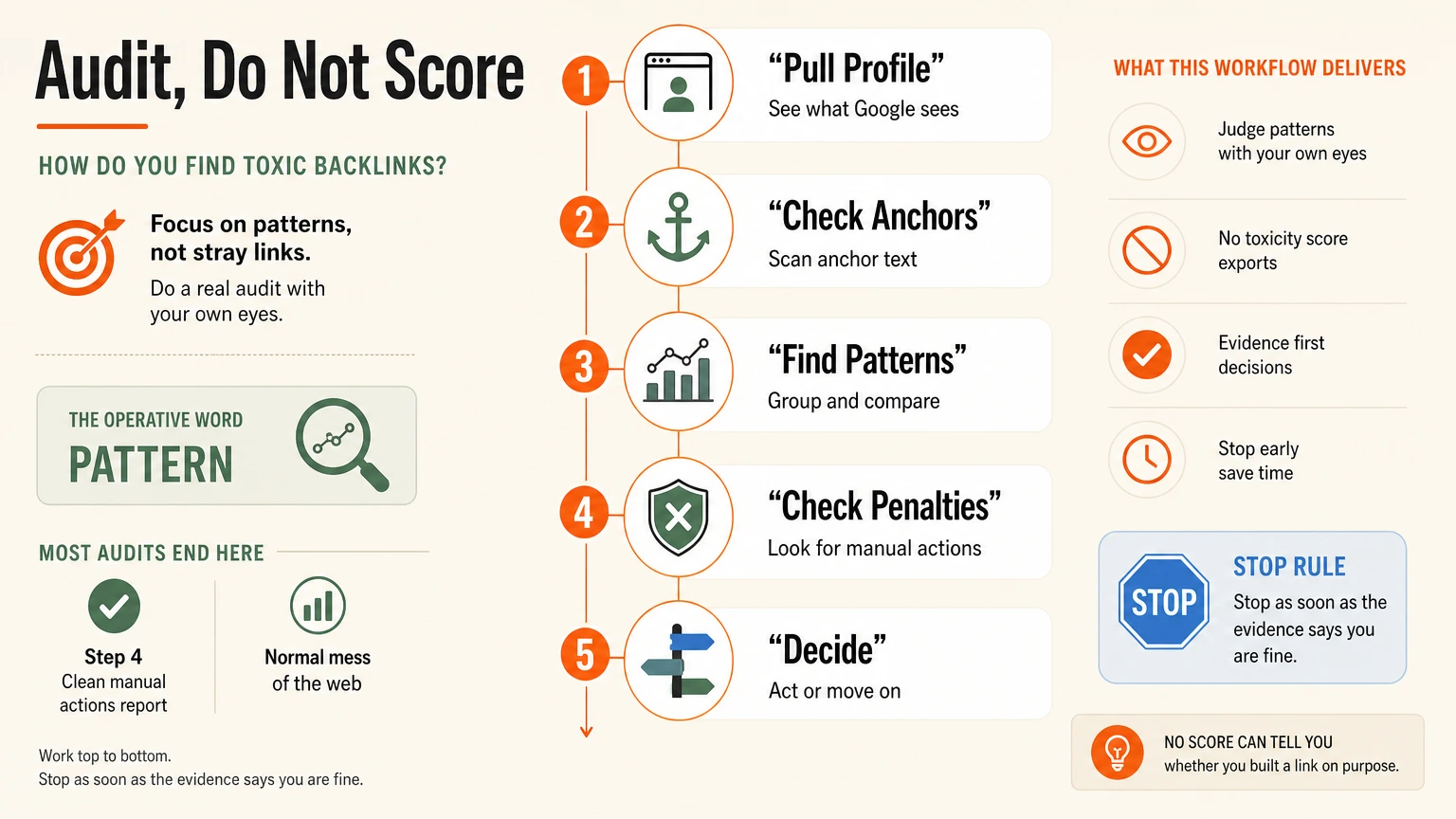
You do a real audit, not a toxicity-score export. The goal is to judge patterns with your own eyes, because no score can tell you whether you built a link on purpose. Here is the workflow I use.
How to audit for genuinely harmful links
Five steps that replace a toxicity score with actual judgment, highest-signal steps first.
Work top to bottom and stop as soon as the evidence says you are fine. In my experience, most audits end at step four with a clean manual actions report and a profile that just looks like the normal mess of the web.
Should you disavow toxic backlinks?
Almost certainly not. Google's own disavow documentation calls it an advanced feature that, used wrong, can hurt your performance in search, and says most sites will never need it.
Google gives exactly two situations that justify a disavow. You have a manual action for unnatural links, or you strongly believe one is coming because of manipulative links you built and cannot get removed. That is the whole list.
- Paid or exchanged links you built to move rankings
- A large PBN or link-farm footprint aimed at your site
- Exact-match anchors at unnatural scale from a scheme
- Anything tied to a manual action in Search Console
- Scraper and junk-directory links you never asked for
- One odd link from an irrelevant or foreign site
- Low-quality links a tool flagged with a high toxicity score
- Random forum and comment links every site attracts
The risk of disavowing when you should not is real, not theoretical. Ahrefs' Patrick Stox once disavowed links to the Ahrefs blog as a test. Traffic dipped, then recovered once he removed the disavow. You can disavow links that were quietly helping you.
The disavow file tells Google to ignore links permanently and it is easy to get wrong. If you do not have a manual action and did not build manipulative links yourself, the safest and most likely correct action is to do nothing at all.
How do you actually remove or disavow them?
Say you are in one of the two real cases. Maybe you inherited a site from an SEO who bought a pile of PBN links, and Search Console shows a manual action. Then, and only then, you work through this in order.
Try removal first. Contact the sites hosting the worst links and ask them to take the link down or add a rel="nofollow" tag. Keep a record of who you contacted.
Build the disavow file. List the domains or URLs you could not get removed, one per line, in a plain text file, following Google's format exactly.
Submit it in Search Console. Upload the file through the disavow tool. Disavow whole domains rather than single URLs when a domain is clearly a spam source.
If there is a manual action, file for reconsideration. Once removals and the disavow are done, submit a reconsideration request explaining what you cleaned up.
Do it carefully and sparingly. A disavow file is not routine maintenance you run every quarter. It is a one-off fix for a specific, diagnosed problem.
What about negative SEO from toxic backlinks?
This is the fear behind most of those red spreadsheets: a competitor points thousands of spam links at you to trigger a penalty. It makes for a good story. It almost never plays out.
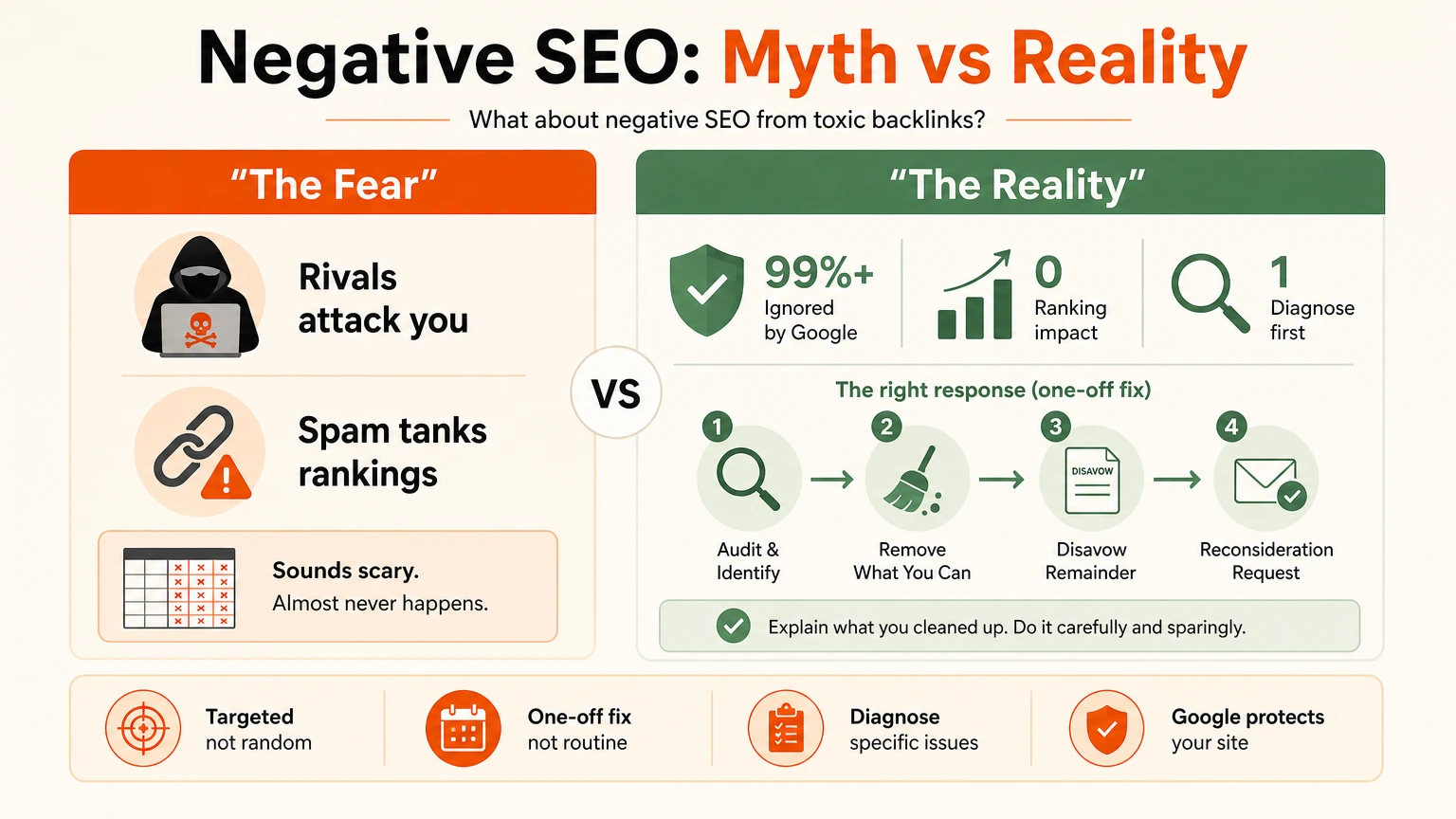
Google's Gary Illyes has said he has looked at hundreds of supposed negative SEO cases and none turned out to be the real cause of the traffic drop. The culprit is usually something else, an algorithm update or a site issue people had not spotted.
When a client is sure a rival attacked them, I ask what else changed that week. Nine times out of ten it is a core update or a technical mistake, not the spam links. Rule those out before you touch the disavow tool.
The sane response is to watch, not panic. If you see a sudden influx of strange links, a tool like our backlink monitor flags the change early, so you can investigate calmly instead of reacting to a scary score.
The better move: stop the problem upstream
Here is where I land after years of this. Almost every hour spent hunting toxic backlinks would pay off more if it were spent not acquiring bad links in the first place. Prevention is the real strategy.
The links that genuinely hurt are the ones you buy or build cheaply and carelessly. Cheap PBN packages, exact-match anchors at scale, and junk directories are what create a toxic profile. Vetted, editorial links on real sites do not.
You cannot disavow your way to authority. You build it by not buying the links you would later regret.Mohammad Qaiser, PRWiz
That is why we build the buying side around quality. Every site in our publisher database is vetted with real metrics, so you start from good inventory rather than filtering out bad links after the fact.
And when there are domains you never want to touch, competitors, low-quality sites, or a client's compliance list, our blacklist manager hides them from every search automatically, so they never make it into your campaign to begin with.
Keep bad domains out before they become links
PRWiz's blacklist manager lets you block competitor, low-quality, and compliance domains across every marketplace search, so a toxic profile never gets a chance to form. Free with every account.
Treat toxic backlinks the way a calm operator does. Audit with your own judgment, disavow only in the two cases Google names, and put your real energy into building links clean enough that you never dread an audit again.