
Casino is the niche where SEO advice goes feral. Open almost any guide on casino link building and within three scrolls someone is telling you that white hat is "unrealistic" here, so you may as well buy PBNs, rent parasite placements on news sites, and grab a few expired domains while you are at it.
I run a link building marketplace, so I see the gambling orders behind the strategy. Here is the part those guides skip: the shortcut they sell is exactly what Google is now hunting, and in a Your Money or Your Life niche, getting caught is not a slap. It is the whole site.
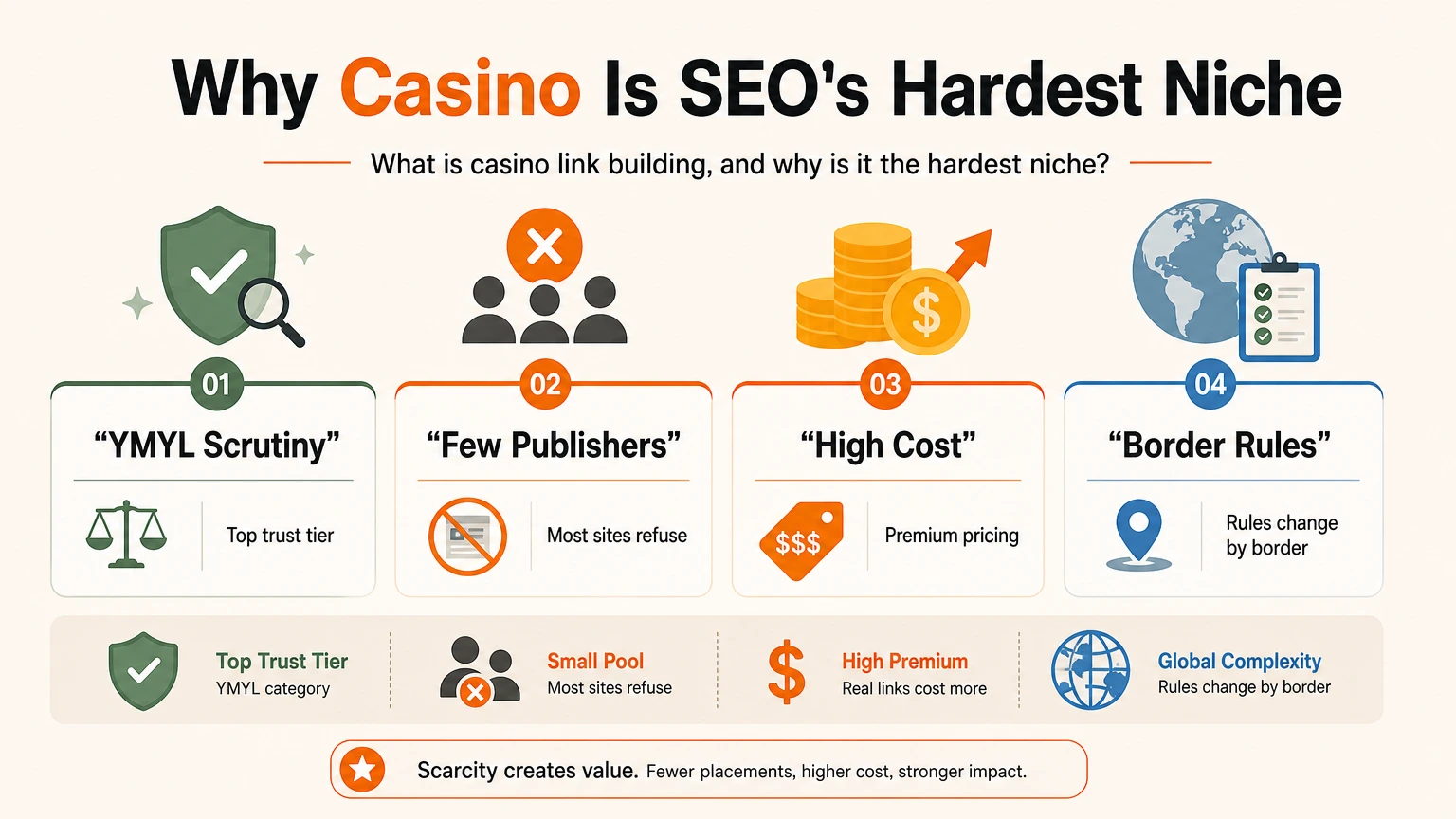
Casino link building is the work of earning backlinks to online casino, betting, and iGaming sites from gambling-relevant publishers. It is the hardest and most expensive niche in SEO, because gambling is a YMYL topic and most publishers refuse gambling links, so every real link is scarce and carries outsized weight.
That scarcity is the whole story. It sets the price, it sets the risk, and it decides which links actually move you.
Key takeaways
- Skip the PBN and parasite shortcut: it is the casino default precisely because it is lazy, and in 2026 Google's site reputation abuse policy is actively delisting the sponsored news placements the niche leaned on.
- Relevance beats borrowed authority: a gambling-relevant page with real traffic moves a casino site further than a DR 90 news domain that has never covered betting.
- Casino carries a real price premium: a gambling guest post runs a median near $186 on a vetted marketplace versus $138 for standard niches, and competitive campaigns reach $40,000 to $50,000 a month.
- Link insertions are the efficiency play: placing your link inside an already-ranked, gambling-relevant page passes equity faster than waiting months for a fresh guest post to mature.
- Vet every publisher before you pay: check real organic traffic, topical and jurisdictional relevance, and the outbound link ratio, not just a domain rating.
- Gambling is YMYL: Google files it under Financial Security in its 2025 rater guidelines, the most scrutinized tier, so footprints and thin links get caught faster here than anywhere.
- Compliance is part of the SEO: a link from a site aimed at a market where your operator is not licensed is a legal exposure, not just a ranking risk.
None of those are theory. They come from current market data and from the gambling orders I watch every week.
What is casino link building, and why is it the hardest niche?
Casino link building is the process of earning backlinks to online casino, sportsbook, poker, and iGaming pages from gambling-relevant publishers. Mechanically it is the same as any link building. The difficulty is the environment around it.
Gambling is a YMYL topic. Google files it under Financial Security in its September 2025 Search Quality Rater Guidelines, the same scrutiny tier as health and money advice. Trust, real authorship, and a clean link profile matter more here than almost anywhere.
Most publishers will not touch it. Gambling sits in the group SEOs politely call the hardest niches, next to adult, pills, and loans. Ad networks block it and editors avoid it, so the pool of willing sites is small. That scarcity is why a real gambling link costs a premium and carries real weight.
The rules change by border. Online gambling is legal and regulated in some markets, banned in others, and decided state by state in the US. A placement that is fine in the UK can be a problem in a country where your operator holds no license.
Do casino backlinks still work in 2026?
Yes, and arguably more than in easier niches. In a market this crowded, with thousands of operators chasing the same terms, links are often the only thing separating two equally polished sites. Backlinko's study of 11.8 million results found the top result carries far more backlinks than the rest of page one. In gambling, that gap is usually the tiebreaker.
There is a catch. Because the niche attracts so much manipulation, Google polices it harder than almost any other. The same scarcity that makes a real gambling link valuable makes a fake one stand out. Spam systems built to catch link schemes are most active exactly where the schemes are densest.
Links still rank casino sites, but the cheap ones do the opposite. In a YMYL niche this heavily policed, a hundred low-quality gambling links are not a head start. They are a liability that one spam update can turn into a deindexing.
The shortcut trap: why PBNs and parasite links are a worse bet than ever
Here is where I part ways with most casino guides. They argue that because clean links are scarce, you have no choice but to go gray or black hat: build a PBN, buy parasite placements on big news sites, redirect expired domains, lean on aggressive anchors. It is sold as realism. It is mostly the lazy path with better marketing.
The parasite move is the clearest example. For years, casinos rented "best online casino" placements inside high-authority newspapers, borrowing a DR 90 domain's trust. Then Google rolled out its site reputation abuse policy and began delisting exactly those sections. Forbes Advisor got hit. Coupon areas of major outlets got pulled. The tactic everyone still recommends is the one being switched off.
In the niche where Google watches hardest, the shortcut everyone sells you is the fastest way to lose the whole site.Mohammad Qaiser, PRWiz
PBNs carry the same flaw. They work until the footprint is found, and in a YMYL niche the footprint is found sooner. When a network gets devalued, every site leaning on it drops together. I have watched operators rebuild from zero after a cheap link sprint torched a domain they had spent two years on. The math never favors the shortcut.
What actually works for casino link building
The durable approach is not exotic. It is relevance first, patience second, and real trust signals stacked over time. Here is how I rank the tactics that actually move gambling sites, by the payoff I see them deliver rather than by how easy they are to run.
What actually moves rankings for casino sites in 2026
Ranked by the impact I see each one deliver for gambling operators, highest first.
Digital PR sits at the top for a reason. A genuine data story or a fast reactive pitch can earn links from sports and gambling media that no amount of bulk buying replicates. Even when those links are nofollow, the coverage and the entity trust are worth it. That is what a managed digital PR campaign is built to do.
Link insertions are the casino efficiency play, and the one most operators underuse. Willing publishers are scarce and a fresh guest post can take months to mature. A link insertion, or niche edit, drops your link into a gambling-relevant article that already ranks and already has inbound authority, so it passes equity far faster. It is the closest thing to a safe shortcut you get in this niche.
With a new casino site, I would spend the first month on relevance, not volume: a few strong link insertions on gambling-adjacent pages, one data asset worth citing, and a real directory listing or two. Resist the urge to buy a bulk gambling package in week one.
Where do casino backlinks actually come from?
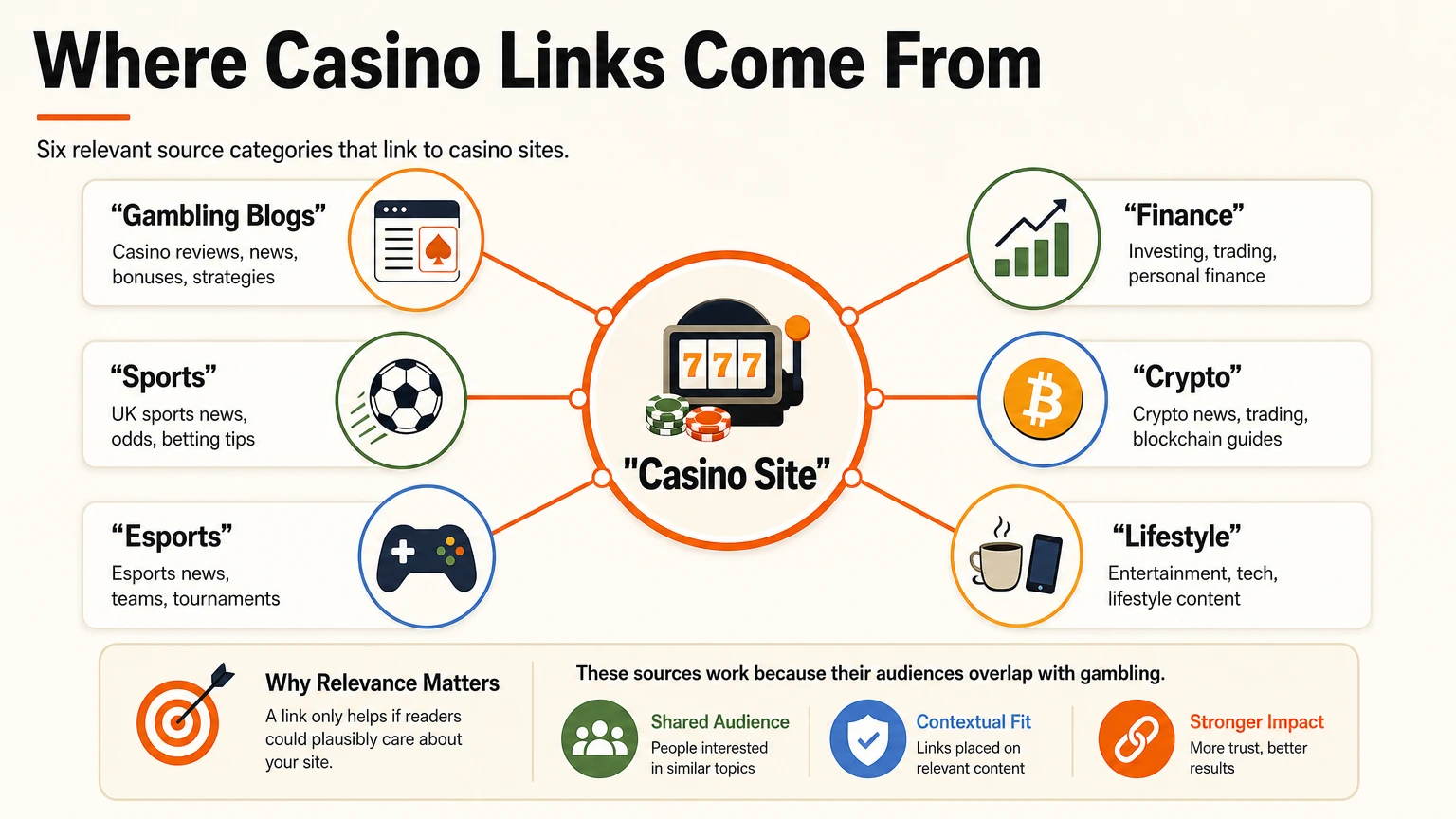
There are not enough pure-gambling sites to build a profile on alone. So the real work happens in the relevant niches next door, what SEOs call shoulder niches. The trick is keeping every placement plausibly relevant to a gambling audience.
The closest sources are gambling and casino blogs, poker and betting strategy sites, and odds or review platforms. Around those sit the shoulder niches: sports (especially UK sports, where ad rules are looser), gaming and esports, finance and crypto (those audiences overlap with gambling heavily), and lifestyle, entertainment, and tech. A link only helps if a reader of that page could plausibly care about your site.
How much does casino link building cost in 2026?
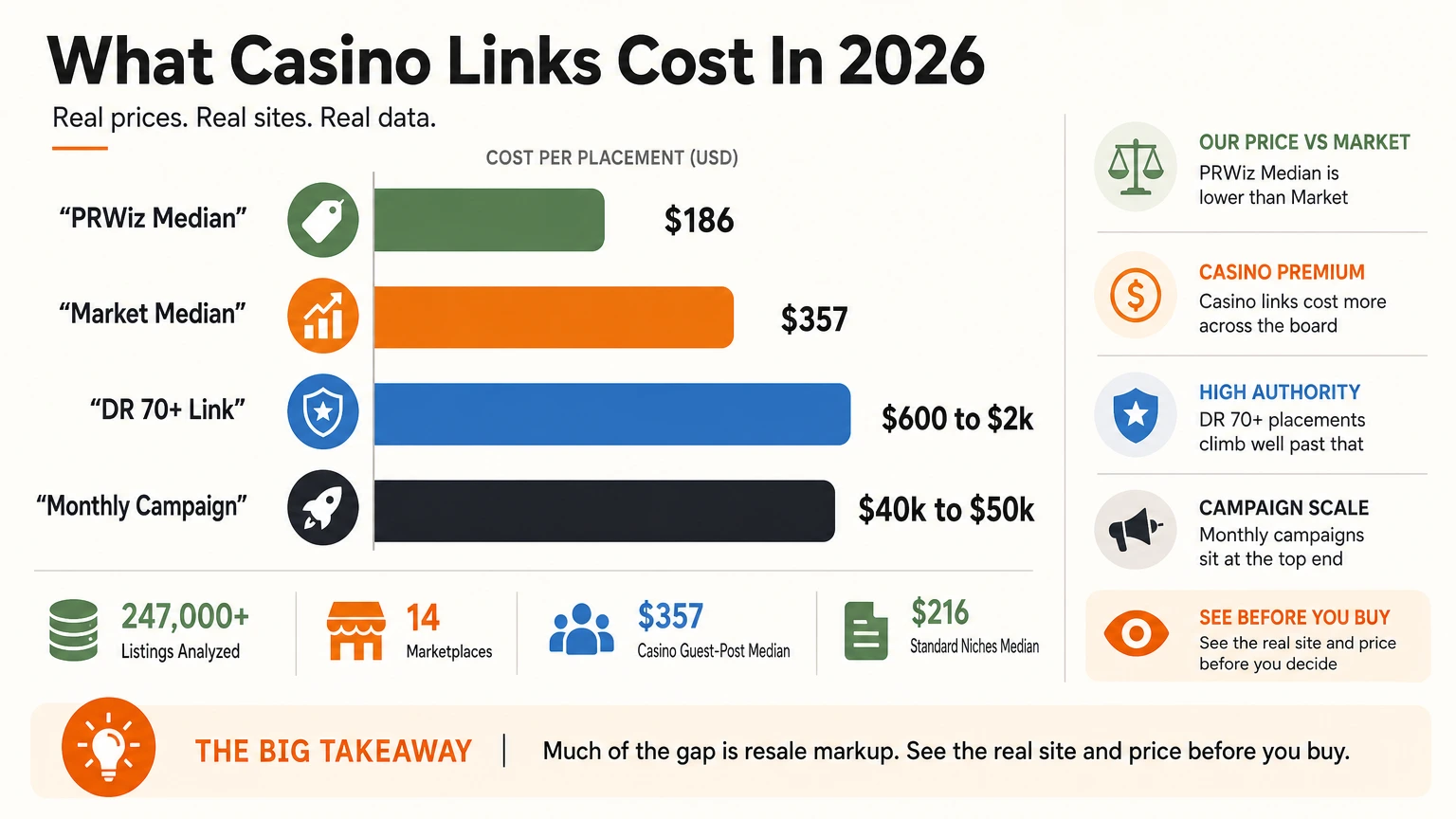
This is where first-party data beats guesswork, because most casino pricing online is secondhand. I run a marketplace, so I can give you the real medians instead of a vibe. Here is what casino links actually run in 2026, as sell-side, listed prices.
Route | Typical 2026 cost | What you actually get |
|---|---|---|
Casino guest post (median) | About $186 on PRWiz, $357 on the open market | New content plus a contextual link on a gambling-relevant site |
Casino link insertion (niche edit) | Cheaper than a guest post, special-niche tier | A link inside a page that already ranks, with no content wait |
High-authority editorial (DR 70+) | $600 to $2,000+ per link | A placement on a strong, gambling-relevant domain |
Digital PR campaign | $5,000 to $10,000 per campaign | Earned editorial coverage, often nofollow, plus entity trust |
Full competitive campaign | $40,000 to $50,000 per month | A managed program for competitive US or UK markets |
On PRWiz, a casino or iGaming guest post runs a median near $186, against $138 for standard niches. So the casino premium at the median is real but modest, roughly a third more, not the wild multiple the niche's reputation suggests. Those are our own sell-side prices, and casino link insertions run cheaper still.
The open market is pricier and noisier. Across our aggregation of more than 247,000 listings from 14 marketplaces, casino guest-post listings show a median near $357 versus $216 for standard niches, and high-authority placements climb well past that. Much of the gap is resale markup, which is the whole case for seeing the real site and price before you buy instead of trusting a package.
How to vet a casino publisher before you pay
More links is the wrong target in gambling. The right ones are relevant, real, and clean, and you can check all three before you spend a dollar. Before I approve a casino placement, I run the same fast checks every time.
I look for real organic traffic, not just a high domain rating, because gambling is full of high-DR sites that sell links and pull no readers. I check the outbound link pattern: if a page already points to thirty casinos with commercial anchors, your link is just one more in a scheme. And I confirm the site is topically and jurisdictionally relevant and actually indexed. A vetted publisher database lets you see those metrics up front, and a backlink monitor tells you the moment a link drops or turns nofollow.
- Sits on a gambling, sports, or finance page with real organic traffic
- Reads like editorial that a human would actually publish
- Matches a jurisdiction your operator is licensed in
- Comes from a site whose other outbound links are clean and on-topic
- Is placed in-content, not in a footer, a sidebar, or a link dump
- Lives on a high DR domain with a few hundred real visitors
- Sits on a page already stuffed with thirty other casino links
- Forces an exact-match commercial anchor into unrelated copy
- Belongs to an obvious PBN sharing IPs and templates with others
- Costs $20 in bulk from a vendor selling the same link to everyone
Compliance and responsible gambling are part of the brief
This is the part most SEO guides skip, and it matters more in gambling than the links do. The rules on how you can promote gambling differ by market, and they are real laws, not guidelines. Build your link plan around the jurisdictions your operator is actually licensed in.
Keep anchors restrained too. Gambling profiles get watched for over-optimization, so a wall of exact-match commercial anchors is a flag in this niche specifically. Brand and topic anchors should carry most of the load, with commercial phrases used sparingly.
A backlink from a site that targets a market where your operator is not licensed can create real regulatory exposure, not just an SEO risk. Match every placement to the jurisdictions you are licensed in, and treat responsible-gambling and disclosure rules as part of the brief, not an afterthought.
In-house, agency, or marketplace for casino links?
All three can work, and the right call depends on your stage, budget, and how much compliance load you want to carry yourself. Here is the honest version of each.
Route | Typical cost | Best for |
|---|---|---|
In-house team | $40,000 to $50,000+ per month all in | Large operators competing in the toughest markets |
Specialist gambling agency | $5,000 to $20,000+ per month | Hands-off scaling with compliance handled for you |
Vetted marketplace | Pay per placement, special-niche tier | Control and relevance without a monthly retainer |
Build in-house when gambling is your whole business and you can hire real outreach and compliance talent. Hire a specialist agency when you want a competitive market handled end to end and the retainer fits. A marketplace fits when you want to see the metrics, choose the sites, and pay per link, which is the model we built PRWiz around. If a bespoke, creative-led PR campaign is what you actually need, an agency may be the better fit, and I would tell you so.
Build casino links you can vet before you buy
Browse PRWiz's vetted publisher network, see real traffic and spam metrics on every site, and place link insertions on gambling-relevant pages that already rank. Pay per placement, with monitoring on every link.
Casino link building is not a game you win with volume. The operators who pull ahead treat it like the high-stakes, heavily watched niche it is: relevance over borrowed authority, a few clean links over a hundred cheap ones, every publisher vetted, and a steady pace instead of a sprint. Do that, and you build a gambling profile that survives the next update instead of fearing it.