
A buyer messaged me last year with a simple plan. He had read that a good link costs about $300, decided he wanted ten of them, and set his link building budget at $3,000. Three months later, nothing had moved.
The links were not the problem. The plan was.
I run a link building marketplace, so I watch this happen every week. People set a budget by multiplying a link price by a link count, then wonder why the number did not buy a result.
Your budget is not a shopping list. It is a bet on a goal, sized to your competition and your stage. Here is how I would set it.
Most businesses should budget $500 to $5,000 a month for link building, scaled to competition and stage. New sites often spend close to zero and fix content first, while competitive niches like finance routinely need $8,000 a month or more. Spend by goal, not by link count.
Before the detail, here is the whole argument on one screen.
Key takeaways
- Set the budget by goal and competition, not by link price: multiplying a $300 link by ten links is how money gets spent with nothing to show for it.
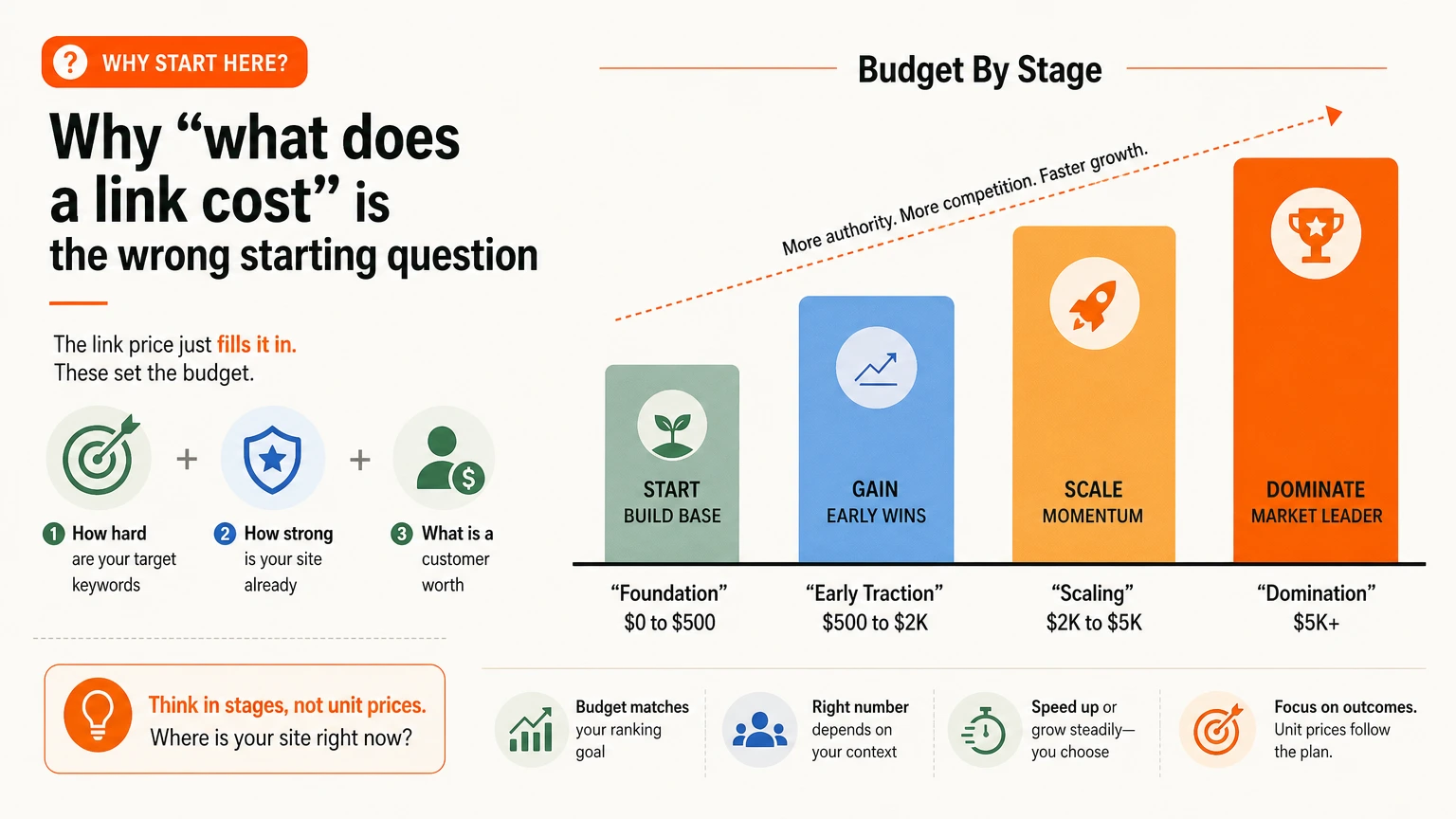
- Plan by business stage: rough monthly ranges run near $0 for a brand new site, $500 to $2,000 early on, $2,000 to $5,000 to scale, and $5,000 to $20,000+ in competitive niches.
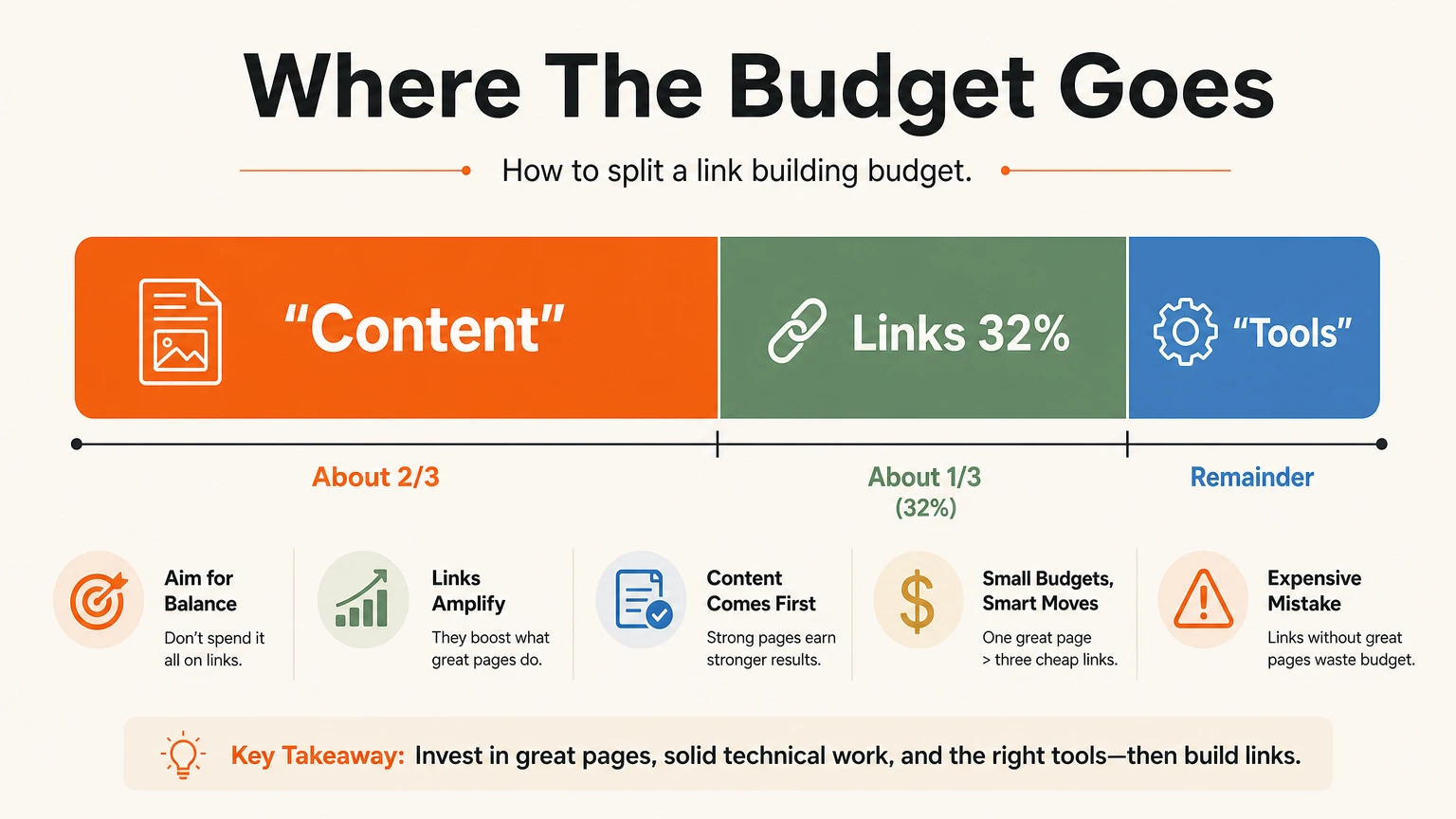
- Put about a third of your SEO budget into links: agencies allocate 32.1% and in-house teams 36% on average, per a 2025 survey of 518 SEO professionals by editorial.link.
- A link is worth a price, not the other way around: if a placement earns you thousands over its life, paying $300 to $1,000 is rational; if it earns you little, even $50 is too much.
- Fund the page before the links: a backlink cannot rank a page that does not deserve to rank, so content and on-page work come first.
- Marketplaces stretch a budget further than retainers: paying per placement, with guest posts from $35 and niche edits from $25, skips the agency markup, so the same money buys more real links.
- The cheapest budget is usually the wasted one: bulk $5 links get ignored by Google, so a smaller spend on a few real links beats a bigger spend on junk.
None of that is theory. It comes from prices I watch every week and from the spending patterns that actually move rankings.
Why "what does a link cost" is the wrong starting question
Almost every pricing guide answers the same narrow question: what does one link cost? The honest answer is somewhere between $35 and $1,500, depending on the site. That range is true, and almost useless for planning.
It is useless because a budget is not a unit price. Two businesses can both pay $300 a link and get opposite results, because one needed three links and the other needed thirty.
A link building budget is a monthly bet on a ranking goal. The right number depends on how competitive your space is, how much authority you already have, and how fast you want to move.
So before you price a single link, answer three things: how hard are your target keywords, how strong is your site already, and what is a customer worth. Those set the budget. The link price just fills it in.
The multiply trap is the most common budgeting mistake I see. People pick a link count out of the air, multiply by a price, and call it a strategy. The link count should be the last thing you decide, not the first.
Once you stop thinking in unit prices, the question gets easier, because it turns into a staging question. Where is your site right now?
That is the real lever, so let me turn it into numbers you can plan around.
Set your link building budget by business stage
The cleanest way to land on a number is to find your stage. A budget that fits a three month old blog would barely register for a funded SaaS company, and the reverse would bankrupt the blog.
Here are the four stages I use, with the monthly ranges I would actually plan around. Treat them as planning brackets, not promises.
Four link building budgets, by where your site is
Find the stage that matches your site today, then plan around its monthly range.
The same brackets, laid out as a planning grid, show where the money actually goes at each stage.
Stage | Monthly link budget | Realistic links per month | Where the money goes | Primary tactic |
|---|---|---|---|---|
Foundation | $0 to $500 | 0 to 2 | Mostly content, links optional | Earned mentions, a few starter placements |
Early traction | $500 to $2,000 | 3 to 8 | Roughly half links, half content | Relevant guest posts and niche edits |
Scaling | $2,000 to $5,000 | 8 to 20 | Links lead, content and tools support | Guest posts, niche edits, quarterly PR |
Competitive | $5,000 to $20,000+ | 20+ | Heavy links plus digital PR | Editorial links and digital PR at volume |
Those link counts assume real, relevant placements, not bulk packages. At marketplace prices, with guest posts from $35 to $285 and niche edits from $25, a $1,000 budget buys several quality links a month. At a typical $300 to $750 agency per-link rate, the same money buys one or two.
Notice what the brackets are really tracking. They rise with competition and with how much your site has earned, not with how impatient you are.
Spend by the goal, not by the link count. The count is the last decision you make, not the first.Mohammad Qaiser, PRWiz
How to split a link building budget
A budget is not just a total, it is an allocation. The total tells you how big the bet is. The split decides whether it works.
In that same editorial.link survey of 518 professionals, agencies put about 32% of their total SEO budget into links and in-house teams about 36%. Call it a third. The rest goes to content, technical work, and tools.
That ratio matters because of a trap I see constantly. Teams spend the entire budget on links and nothing on the pages those links point at. It is the most expensive mistake in SEO.
If you only have a few hundred dollars, one genuinely useful page will almost always beat three cheap links. Links amplify what a good page already does, and they cannot create it from nothing.
Here is the difference between a budget that compounds and one that drains.
- About a third to links, the rest to content and tools
- Fewer, relevant placements on sites with real traffic
- Money held back to fix the target page first
- A steady monthly pace that builds a natural profile
- Every link monitored so you know it stayed live
- The whole budget on links, nothing on the page
- Bulk cheap links bought on DR alone
- A thin page that no link could rescue
- A one-time blast of links all at once
- No tracking, so dead links quietly waste the spend
Whatever you spend, track every placement, because a link that drops or turns nofollow is part of your budget walking out the door unnoticed.
How to put a real number on it
If the brackets feel too broad, there is a sharper way to size the bet. It comes from Siege Media, and it is called lifetime link value: what is a link actually worth to you?
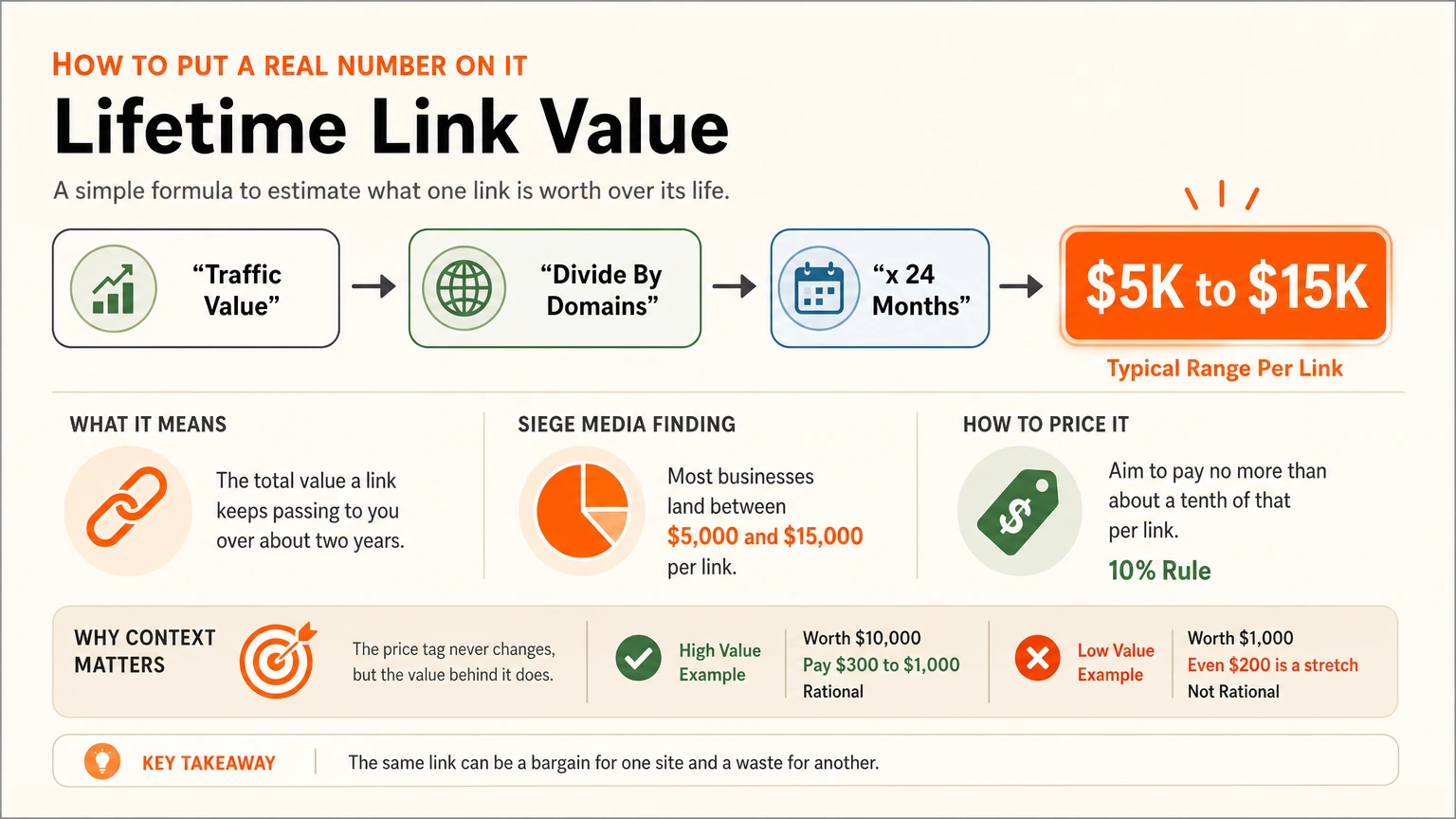
The rough math: take the monthly traffic value of the leading site in your niche, divide it by its number of referring domains, then multiply by 24 for the two years or so a link keeps passing value.
Run that, and Siege Media finds most businesses land between $5,000 and $15,000 per link. Then aim to pay no more than about a tenth of that per link, to leave room for the ones that miss.
If a link is worth $10,000 to you over its life, paying $300 to $1,000 is rational. If it is worth $1,000, even a $200 link is a stretch.
This is why the same link can be a bargain for one site and a waste for another. The price tag never changes, but the value behind it does.
You do not need to run this to two decimal places. You need it accurate enough to know whether you are in a $200 link niche or a $1,000 link niche, because that single fact reshapes the whole budget.
A link is only worth what it earns you. Pay up when that number is high, and walk away when it is not.Mohammad Qaiser, PRWiz
Where a budget stretches further
Two businesses with the same $2,000 a month can buy very different amounts of link, depending on how they spend it.
An agency retainer bundles strategy, outreach, content, and placement into one monthly fee, usually $3,000 to $12,000. You pay for the service wrapped around the link, which is worth it when you have budget but no time.
A marketplace sells the placement directly. You pick the site, you see its real metrics before paying, and you skip the retainer and the reseller markup. The same money buys more real links.
A $2,000 monthly budget | On a marketplace | On an agency retainer |
|---|---|---|
What you pay for | The placement itself | The service plus the placement |
Rough links per month | 6 to 15 quality placements | Often below the typical $3,000 minimum |
Site choice | You pick each site and see metrics | The agency chooses for you |
Best when | You want control and proof | You want it fully handled |
Neither is the right answer for everyone. If you need a narrative digital PR campaign that earns national coverage, a specialist agency will beat any catalog of placements.
If you want control and proof per dollar, a marketplace wins. Mixing niche edits and guest posts inside one budget is usually the most efficient split.
Make every dollar of your budget visible
PRWiz lists 2,500+ vetted publishers with live DR, traffic, and spam score, and you pay per placement from $35. Browsing is free, so you can price a real plan before you commit a cent.
When to spend less, or nothing yet
The most useful budgeting advice I can give sometimes costs me a sale. Do not buy links at all right now.
Hold your budget if any of these are true:
Your site is brand new. Links to a thin site look engineered and rank nothing. Build a foundation of content first.
The target page is not ready. No link rescues a weak page. Fix the page, then point links at it.
Your budget is tiny. Under a few hundred dollars, a single strong page beats a pile of cheap links.
You expect overnight results. Links take weeks to register, so a budget set for next week is a budget set for disappointment.
None of that means link building does not work. It means timing the spend is part of spending it well.
If you are not sure which stage you are in, look at whether your best pages already get clicks. If they do, links will amplify them and the spend is justified. If they do not, your first dollars belong in content, not links.
Frequently asked questions
How much should a small business spend on link building per month?
How much of my SEO budget should go to link building?
How many backlinks do I need per month?
Is link building worth the money in 2026?
Can you do link building on a small budget?
How much should a startup spend on link building?
So here is the recommendation I give people who are not paying me for it. Decide what a ranking is worth to you, then find your stage.
Set a monthly number you can sustain for six months, because that is about how long links take to pay off.
Then spend it on fewer, better links and a page worth linking to. That is the whole budget, and it beats any number multiplied by a guess.