
Most SaaS teams I watch are building links to the wrong page. They pour budget into blog posts, watch the domain rating tick up a point, and wonder why trials never move. The links are fine. They are just aimed at content that was never going to convert a buyer.
I run a link building marketplace, so I get to see the orders behind the strategy: which placements software companies actually buy, where they point them, and which ones move a ranking that pays. This is the playbook I would give a SaaS founder or head of growth over coffee, not a list of tactics you have read ten times.
SaaS link building is the work of earning relevant backlinks from tech, B2B, and software publishers, then pointing them at the pages buyers convert on: product, pricing, and comparison pages. In 2026, relevance and link placement beat raw domain rating and volume.
That last sentence is the whole article in miniature. The rest shows you how to act on it, what it costs, and where most teams quietly waste the money.
Key takeaways
- Point links at pages that convert, not just the blog: the SaaS teams that win send authority to product, pricing, and comparison pages, which is exactly where most teams never build.
- Relevance beats domain rating: a DR 40 B2B software blog with real traffic moves your rankings more than a DR 80 general news site that never covers your space.
- Comparison and review placements are the SaaS edge: best-of listicles, competitor alternatives pages, and profiles on G2 or Capterra reach buyers while they decide, and more than 90% of B2B buyers read reviews before they shortlist.
- Backlinks still settle close races: the number one result has about 3.8 times more backlinks than positions two to ten, per Backlinko, and that gap is the tiebreaker when content is even.
- Budget by route, not by hope: marketplace placements run about $35 to $285 each while agencies charge $400 to $800 per link, so the same spend buys very different volume.
- AI search rewards the same work: with more than half of software buyers now starting research in tools like ChatGPT, the links and mentions that rank you are also what get you cited.
- Consistency beats bursts: roughly 15 to 25 relevant links a month at the right pages moves rankings in 60 to 90 days, while a one-time splurge fades.
Those numbers come from current market data and from orders I see every week, not from a rate card I am trying to sell you.
What is SaaS link building, and why is it different?
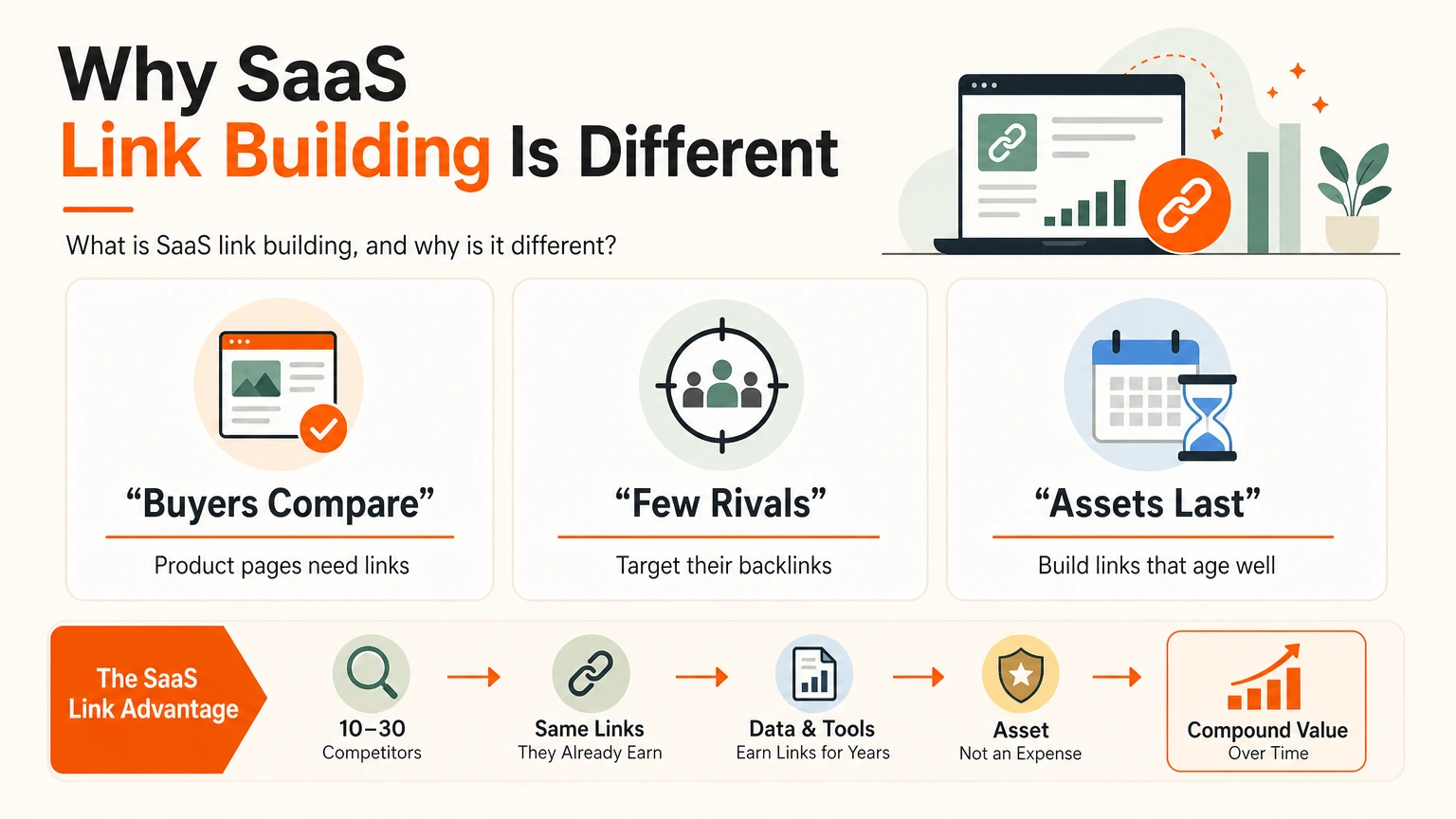
SaaS link building is the process of earning backlinks from tech, B2B, and software-relevant sites to improve search rankings and put your product in front of buyers. The tactics overlap with any link building, but three things make SaaS its own game.
Your buyers compare before they commit. A software purchase involves demos, feature checks, and a few stakeholders. That means your product, pricing, and comparison pages need authority, not just your blog. Those are the pages a buyer reads on the way to a decision.
Your competitor set is narrow and named. You are not fighting the whole internet. You fight ten to thirty specific companies for the same keywords, and the links you need sit on the exact sites that already link to them.
Your best assets age well. A solid data study or a free tool built on your product can earn links for years. That turns link building from an expense into an asset, but only when you build to pages and assets that deserve it.
Do backlinks still matter for SaaS in 2026?
Yes, and the data is not subtle. Backlinko's analysis of 11.8 million search results found the number one result has on average 3.8 times more backlinks than positions two through ten. When two SaaS pages are equally good, links are the tiebreaker.
Links also buy you independence from paid search. Core SaaS category terms are brutal in Google Ads, with top-of-page bids on terms like CRM or email marketing software often running $30 to $50 or more per click. A link is bought once and keeps working. A click is rented.
Then there is AI search, the question every SaaS founder is asking. More than half of software buyers now begin research inside tools like ChatGPT, and in one 2026 study every tool it recommended had a Capterra profile and nearly all had G2 reviews. The same authority signals that rank you are what get you surfaced.
Top-of-funnel 'what is' content is now mostly a citation play, not a traffic play. With AI Overviews answering the question right on the results page, the durable SaaS wins are your bottom-funnel comparison and product pages, plus being the source the AI quotes.
The operator's rule: build links to pages that convert
Here is the single biggest lever, and the one most teams miss. Point your authority at the pages where buyers actually convert: product, pricing, comparison, and integration pages. Most SaaS companies send every link to blog posts and leave their money pages with almost no external links at all.
There is a reason for that. Product and comparison pages are the hardest pages to earn links to naturally, because nobody links to a pricing page out of generosity. Which is exactly why doing it is an advantage. Your competitors find it awkward too, so the field is open.
For SaaS, the page you point the link at matters more than the link itself.Mohammad Qaiser, PRWiz
This is also where a link insertion earns its keep. Placing a contextual link inside an article that already ranks and already has traffic can send authority straight to a product or comparison page, faster than waiting on a brand-new guest post to mature.
The SaaS link building tactics that actually work
Every guide lists the same dozen tactics. The useful question is which ones pull weight for software specifically. Here is how I rank them by the payoff I see them deliver, not by how easy they are to run.
What actually moves rankings for SaaS in 2026
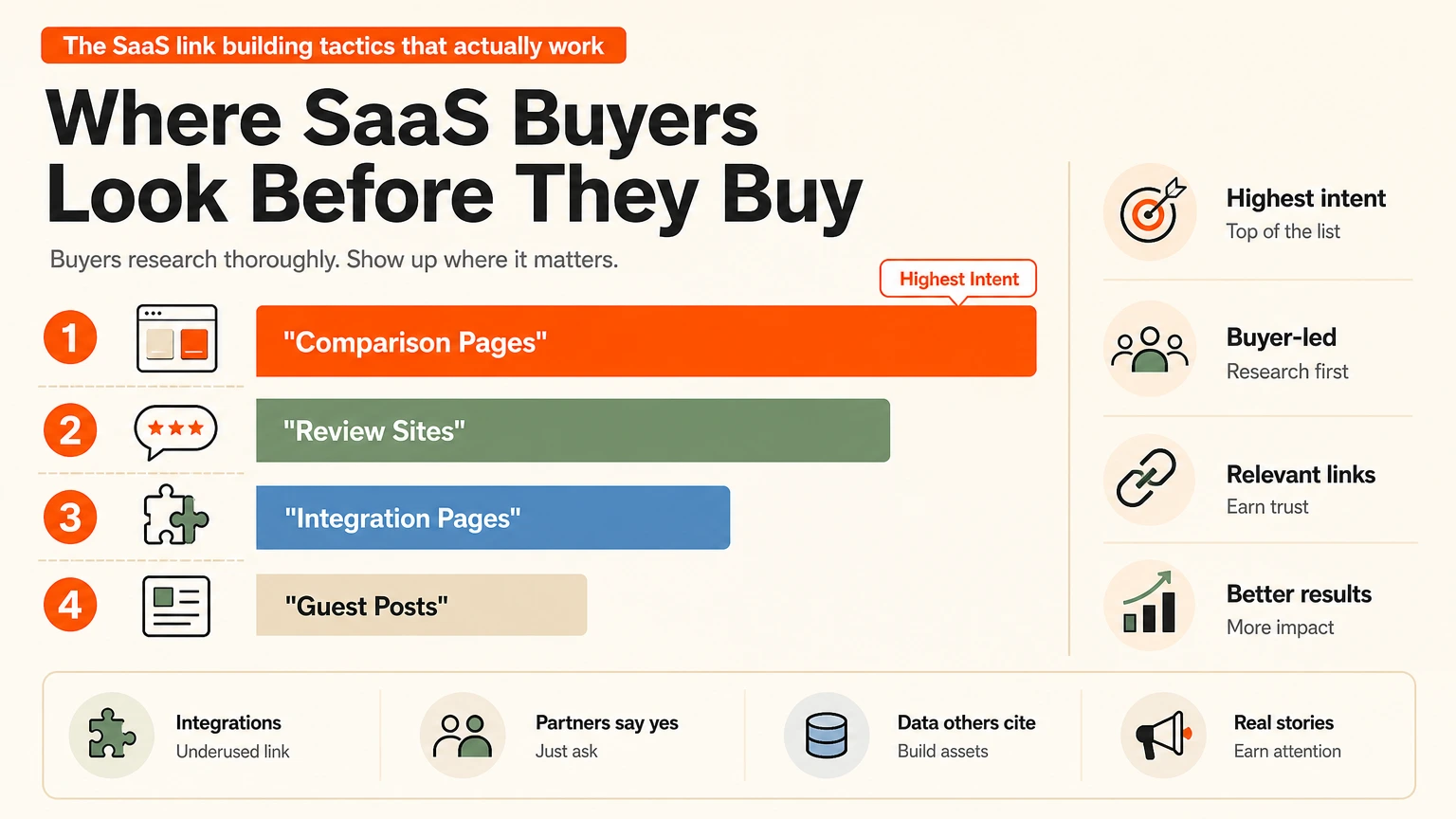
Ranked by the impact I see each one deliver for software companies, highest first.
Comparison and alternatives placements come first for a reason. When a buyer searches for an "Asana alternative" or the "best project management software," that page is the last thing they read before a trial. Getting included there, with a fair and accurate entry, is the highest-intent link in SaaS.
Review platforms are non-negotiable. Keep real, complete profiles on the few that buyers and AI tools actually use. A handful of these beats two hundred generic directory submissions, which do nothing.
Integration and partner pages are the most underused link in software. If your product connects to a bigger platform, its integration directory, docs, and co-marketing are some of the most relevant links you will ever earn. Ask. Most partners say yes.
Below that sit the classics that still work: a genuine data asset others cite, guest posts on publications your buyers read, reclaiming unlinked mentions, and digital PR for the times you have a real story or number to share.
How much does SaaS link building cost in 2026?
It depends entirely on how you buy. The same link can cost you $35 or $800, and the gap is mostly the layer of service wrapped around it. Here are the three routes and what each really runs in 2026.
Route | Typical 2026 price | What you get | Best for |
|---|---|---|---|
In-house team | $3,000 to $8,000 per month | Full control, but salary, tools, and time, and slow to build relationships | Specialized niches and high, steady volume |
Specialist agency | $400 to $800+ per link, or $2,000 to $15,000+ per month | Done-for-you outreach on an existing publisher network | Fast authority in a competitive vertical, hands-off |
Link marketplace | Guest posts about $35 to $285, insertions from $25 | See the metrics and domain first, then pay per placement | Control and relevance at the lowest cost per link |
The in-house and agency figures are industry numbers (Outreach Desk pegs in-house at $3,000 to $8,000 a month, and agencies such as Above Apex list from $400 per link). The marketplace prices are public, sell-side rates: on PRWiz guest posting, standard placements start at $35, the mid-authority sweet spot sits near $95, and elite sites start at $285.
Buy four to eight relevant placements, point most of them at a comparison or product page, and set a little aside for one data asset you can pitch later. Resist the urge to spend the whole budget lifting your blog.
How to tell a good SaaS link from a bad one
More links is the wrong goal. The right links are relevant ones, and relevance is now the whole game. A DR 40 operations blog your buyers actually read will move you further than a DR 80 general news site that has never covered software.
A DR 40 site your buyers actually read beats a DR 80 site they have never heard of.Mohammad Qaiser, PRWiz
Before I approve a placement, I check five things fast: is the site topically relevant, does the linking page have real organic traffic, are there named authors and editorial standards, is the link neighborhood clean, and is the page actually indexed. Our vetted publisher database exists so you can see those metrics before you pay instead of guessing.
- Sits on a site that regularly publishes about software or your buyer's job
- Has real organic traffic to the linking page, not just a high DR
- Points at a product, pricing, comparison, or genuinely relevant page
- Reads like editorial a human would actually publish
- Comes from a site whose other outbound links are clean and on-topic
- Lives on a general site that covers everything and nothing
- Shows a high DR but a few hundred visitors and no tech content
- Sits in a footer, an author bio, or a page Google does not index
- Appears next to links to casinos, loans, and pharma
- Is bought in bulk with the same exact-match anchor every time
A SaaS link building plan by stage
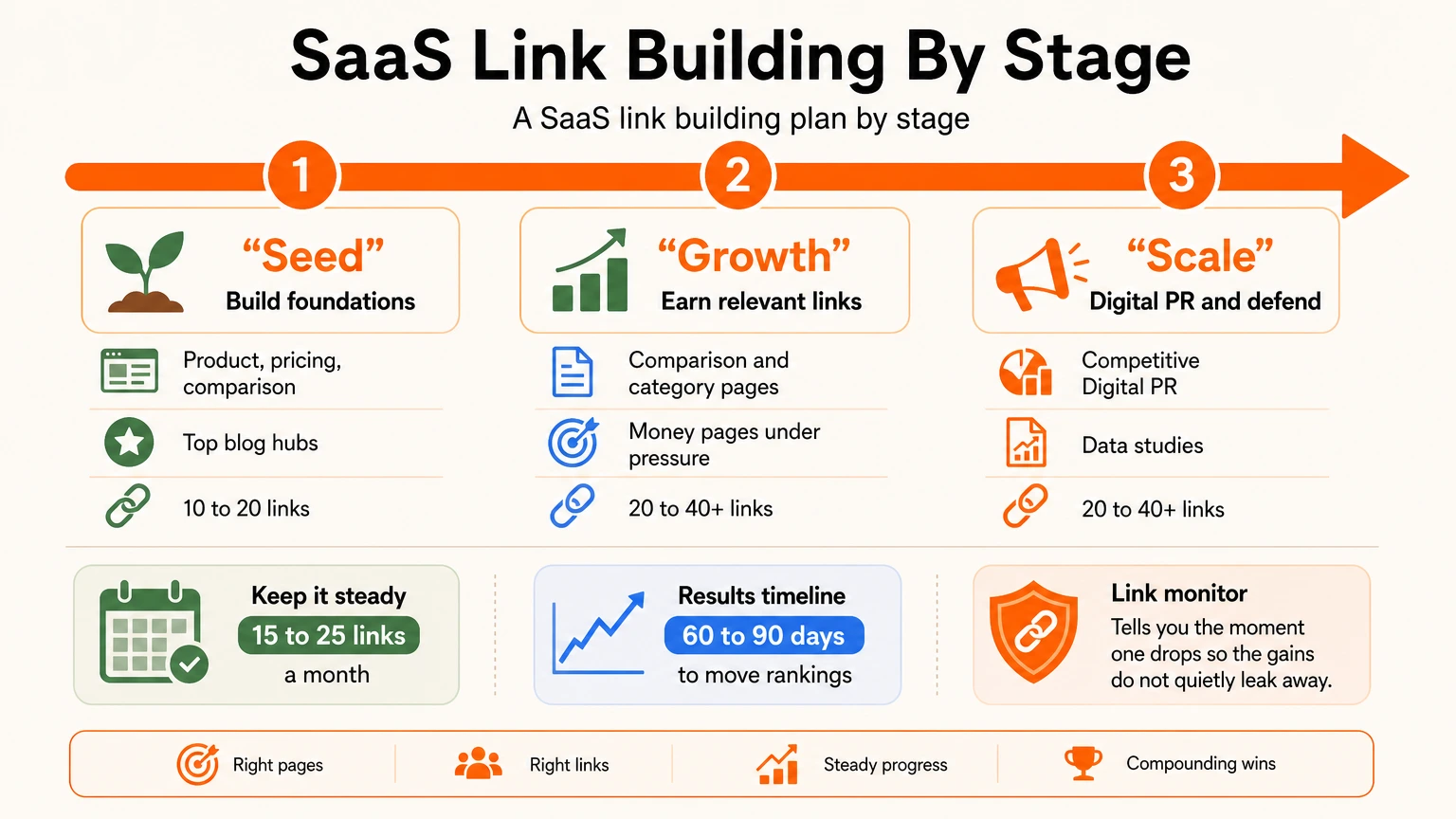
What you should do depends on where the company is. Spending like a Series B brand when you are pre-product-market-fit just burns runway. Here is roughly how I would sequence it.
Stage | Monthly focus | Where to point links | Sensible volume |
|---|---|---|---|
Pre-PMF or seed | Foundations: directories that matter, integrations, unlinked mentions | Homepage, key integration and product pages | 3 to 8 links |
Series A or growth | Relevant guest posts, comparison-page links, a first data asset | Product, pricing, comparison, top blog hubs | 10 to 20 links |
Scale or competitive | Digital PR, data studies, defending won rankings | Comparison and category pages, money pages under pressure | 20 to 40+ links |
Whatever the stage, keep it steady. Roughly 15 to 25 relevant links a month, aimed at the right pages, tends to move rankings within 60 to 90 days, and a link monitor tells you the moment one drops so the gains do not quietly leak away.
Common SaaS link building mistakes
The expensive mistakes are not about spending too little. They are about aiming wrong. The ones I see drain the most budget:
Linking only to the blog. Your highest-converting pages end up with no authority, so they never rank.
Chasing DR over relevance. A big number from an unrelated site sends a weak signal at best.
Mass directory submissions. Two hundred generic listings do nothing; eight relevant ones help.
One-and-done campaigns. Stop for a quarter and competitors who kept going pass you.
The same exact-match anchor everywhere. It is the easiest over-optimization pattern for Google to spot.
When a vendor offers software links by the dozen at $20 each, that is the bottom of the pool: sites built only to sell links, with no readers and no connection to your category. For SaaS, one relevant placement beats fifty of those.
In-house, agency, or marketplace?
All three can work, and the right call depends on your stage, budget, and team. Build in-house when you have outreach skill on staff, want total control, and your niche is so specialized that only you can credibly write about it. Hire an agency when you need to scale fast in a competitive vertical and want it fully handled.
A marketplace fits when you want the relevance and price of doing it yourself without the overhead: you see the domain and metrics, choose the sites, and pay per placement. That is the model we built PRWiz around. And if you need a bespoke, hands-off digital PR campaign with custom creative, an agency may still be the better fit. Say so when it is true, because the trust is worth more than the order.
Build SaaS links you can see before you buy
Browse 2,500+ vetted publishers on PRWiz, filter by niche, traffic, and authority, and point real placements at the pages that convert. Pay per placement, guest posts from $35, with monitoring on every link.
None of this is exotic. Aim links at the pages that make you money, buy relevance over vanity metrics, and keep a steady pace. Do that for a few quarters and you pull ahead of the SaaS companies still quietly feeding their blog.