
You can buy backlinks safely. The catch is that safe does not mean what most guides selling you links want it to mean.
It does not mean risk free, and it does not mean a shortcut to page one by Friday.
I run a link building marketplace, so I watch what buyers actually pay and what happens to their rankings afterward.
This is the honest version: what Google really does about paid links, where the risk lives, and how to buy without burning your money.
You buy backlinks safely by paying for editorial placements (guest posts, niche edits, digital PR) on real, relevant sites with genuine traffic, and verifying each one before you pay. The realistic risk in 2026 is wasted money, not usually a Google penalty.
Before the detail, here is the whole argument on one screen.
Key takeaways
- You can buy backlinks safely, but never risk free: paid links that pass ranking credit break Google's spam policy, so safety means managing risk, not pretending it is zero.
- The common failure is wasted money, not a penalty: Google now mostly ignores manipulative links instead of punishing you, so a bad buy usually just does nothing.
- Relevance and real traffic decide everything: a link from a relevant site with genuine organic readers is both the safest and the most effective, every time.
- Know the fair price: Ahrefs found guest posts average about $78 and niche edits about $361, and marketplace placements start near $35, so a $5 link and a $1,500 link are both warning signs.
- Control the footprint: vary your anchor text, keep velocity natural, and avoid exact-match anchors, because a clumsy pattern is what actually triggers a manual action.
- Some buys are not worth making: a brand new site, a thin target page, or a tiny budget are all signs to fund content first and buy links later.
- Verify before you pay: if you cannot see the site, its live metrics, and confirm it is real, that is not a deal, it is a gamble.
None of that is theory. It comes from prices I watch every week and from the patterns that survive Google's updates.
What buying backlinks actually means
Buying a backlink means paying a site owner to place a link to you. In practice it is four things, and they carry very different risk.
Guest posts are articles you pay to publish with a link back. Niche edits, also called link insertions, drop your link into an article that already exists.
Sponsored posts are paid placements labeled as such. Digital PR earns links from real publications through outreach you run or pay an agency to run.
All four are paid. What separates them in Google's eyes is not the label, it is whether the link is built to pass ranking credit and whether a real editor would have allowed it anyway.
What Google actually does about paid links
Start with what Google actually says, not what a vendor claims it says. Google's spam policies list "buying or selling links for ranking purposes" as link spam, and that explicitly includes "exchanging money for links, or posts that contain links."
Read one paragraph further, though, and Google says the part most guides skip.
Buying and selling links is "a normal part of the economy of the web," and it is not a violation as long as the paid link is qualified with a rel="nofollow" or rel="sponsored" tag.
So the line is specific. A paid link that passes ranking credit is the violation, and a paid link that does not pass credit is fine.
Safe buying is about staying on the right side of that line while still earning links that genuinely count.
Here is the part that should change how you think about risk. Since its 2022 link spam update, Google leans on an AI system called SpamBrain to neutralize unnatural links, which means ignore them, rather than hand out penalties.
Manual actions still exist, and they are brutal when they land, but they are rare and usually reserved for obvious, large scale spam.
In seven plus years of buying and brokering links, the outcome I see most from a bad purchase is not a penalty. It is a link sitting on a dead page, moving nothing. Google ignored it, and the buyer paid full price anyway.
That reframe matters because it tells you where to aim. You are not mainly buying your way around a penalty.
You are trying not to waste money, which means the test for any link is simple: would it exist, and get clicks, if money never changed hands?
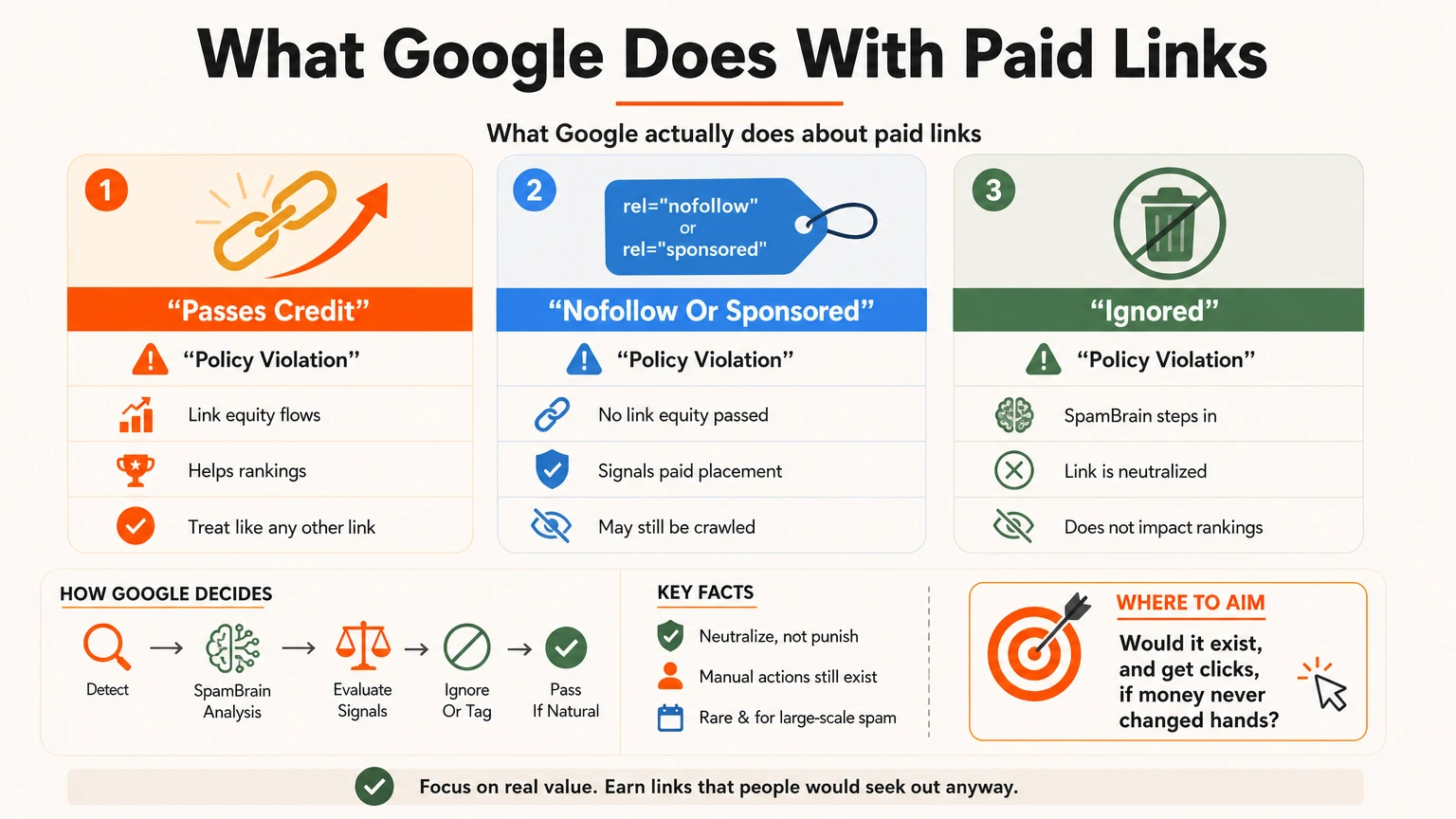
The takeaway is narrow: stay clear of the violation, and refuse to pay for links that end up ignored.
The realistic risk of a bad link buy in 2026 is not a penalty. It is paying full price for a link Google has already decided to ignore.Mohammad Qaiser, PRWiz
The two risks you are really managing
Once you accept that penalties are rare, buying backlinks safely comes down to managing two risks at once, and they are not equal.
Wasted money is the common one. You pay $200 for a DR 50 link on a page with no traffic, and Google never counts it.
A bad footprint is the rare but serious one: a sudden burst of exact-match anchors from low quality sites that looks engineered enough to earn a manual action.
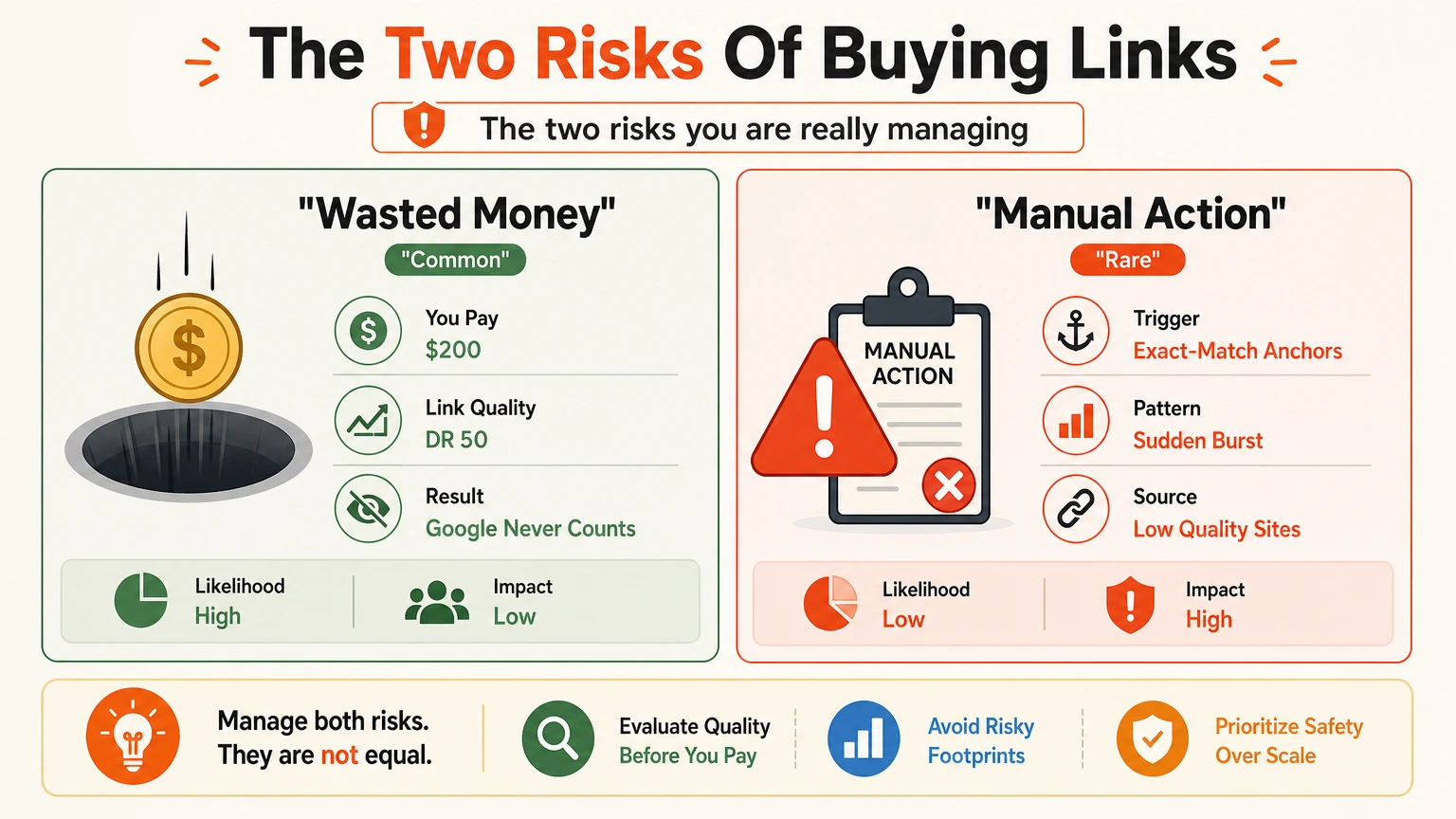
The good news is that one discipline handles both. Buy links a real editor might have given you anyway, and you are covered on each front.
When I score a link before buying, five things decide it, and I weigh them roughly like this.
What makes a bought link safe and worth it
The five factors I weigh before paying for any link, in rough order of how much they decide the outcome.
How to buy backlinks safely, step by step
Turn those factors into a routine. This is the order I walk buyers through, and skipping a step is usually how money gets wasted.
Fix the target page first. A link points at a page. If that page is thin or brand new, no link will rank it. Earn or write something worth linking to before you spend.
Filter for relevance and traffic, not DR. Start with sites in or near your niche that have real organic visitors. Domain Rating is a sorting tool, not a verdict.
Verify before you pay. See the live site and its real metrics, check traffic in Ahrefs or Semrush, and read a recent article. If you cannot confirm it is real, walk.
Control anchor text and pace. Lead with branded and partial-match anchors, save exact-match for rare cases, and add links steadily rather than all at once.
Track that the link stays live. Links get removed, deindexed, or quietly switched to nofollow. Monitor every placement so you know what you actually bought.
Hold each candidate against that routine and the difference between a safe buy and a gamble gets obvious fast.
- Relevant site with real, verifiable organic traffic
- You see the domain and live metrics before paying
- Editorial placement inside the body content
- Branded or partial-match anchor text
- Monitored, with a replacement if it drops
- High DR but almost no real traffic
- Mystery package, domain hidden until you pay
- Bulk offer like fifty links for fifty dollars
- Exact-match anchors blasted all at once
- No live URL, no monitoring, no accountability
What should you pay for a backlink in 2026?
Pricing in this industry is deliberately foggy, so let me clear some of it.
Ahrefs studied real outreach across 180 sites and found a guest post link averaged about $78 for the placement, while a niche edit averaged about $361.
The Editorial 2025 survey puts the figure SEOs say they will pay for a quality link near $509.
All three numbers are skewed upward by the premium end. The honest spread depends on what you are buying and the authority behind it.
Here is what a fair price looks like, and what should make you pause.
What you are buying | Typical fair price (2026) | Warning signs |
|---|---|---|
Niche edit / link insertion | $25 to $200 on a marketplace | Under $20 in bulk, or $400+ on a site with no traffic |
Guest post (mid authority) | $35 to $200 for the placement | $5 to $30 "packages", or $1,500 for DR alone |
High-authority editorial link | $250 to $600 and up | Any price on a site with no real readers |
Digital PR / HARO feature | Free to about $99 per win via a service | Guaranteed national press for a flat fee |
"100 backlinks for $50" packages | Not a real option | The entire offer |
For a concrete anchor, PRWiz guest posts list from $35 on standard publishers, $95 in the mid authority range, and $285 and up on top tier sites, with niche edits from $25.
Marketplaces sit at the low end of every range because you skip the agency retainer and the reseller markup, not because the sites are worse.
A fifty links for fifty dollars offer is selling placements on sites built only to sell links. Google ignores most of them, and the rest can drag your profile down. Cheap links are usually the most expensive line in an SEO budget.
When should you NOT buy backlinks?
This is the part the selling guides skip, so let me be useful instead of promotional. Buying links is the wrong move more often than the industry admits, and walking away is sometimes the smartest spend.
Your site is brand new with no content. Links to a thin site look engineered and rank nothing. Build the foundation first.
The target page is not ready. No link rescues a thin or duplicate page. Fix the page, then point links at it.
Your budget is tiny. If you have $300, one genuinely useful page will usually beat three cheap links.
You are in a YMYL niche without care. Health, finance, and legal need relevance and credibility, not bulk placements.
You expect overnight results. Links take weeks to matter, and anyone promising a ranking by a date is selling you a footprint.
You cannot vet the site. If you cannot see it and verify it, do not buy it.
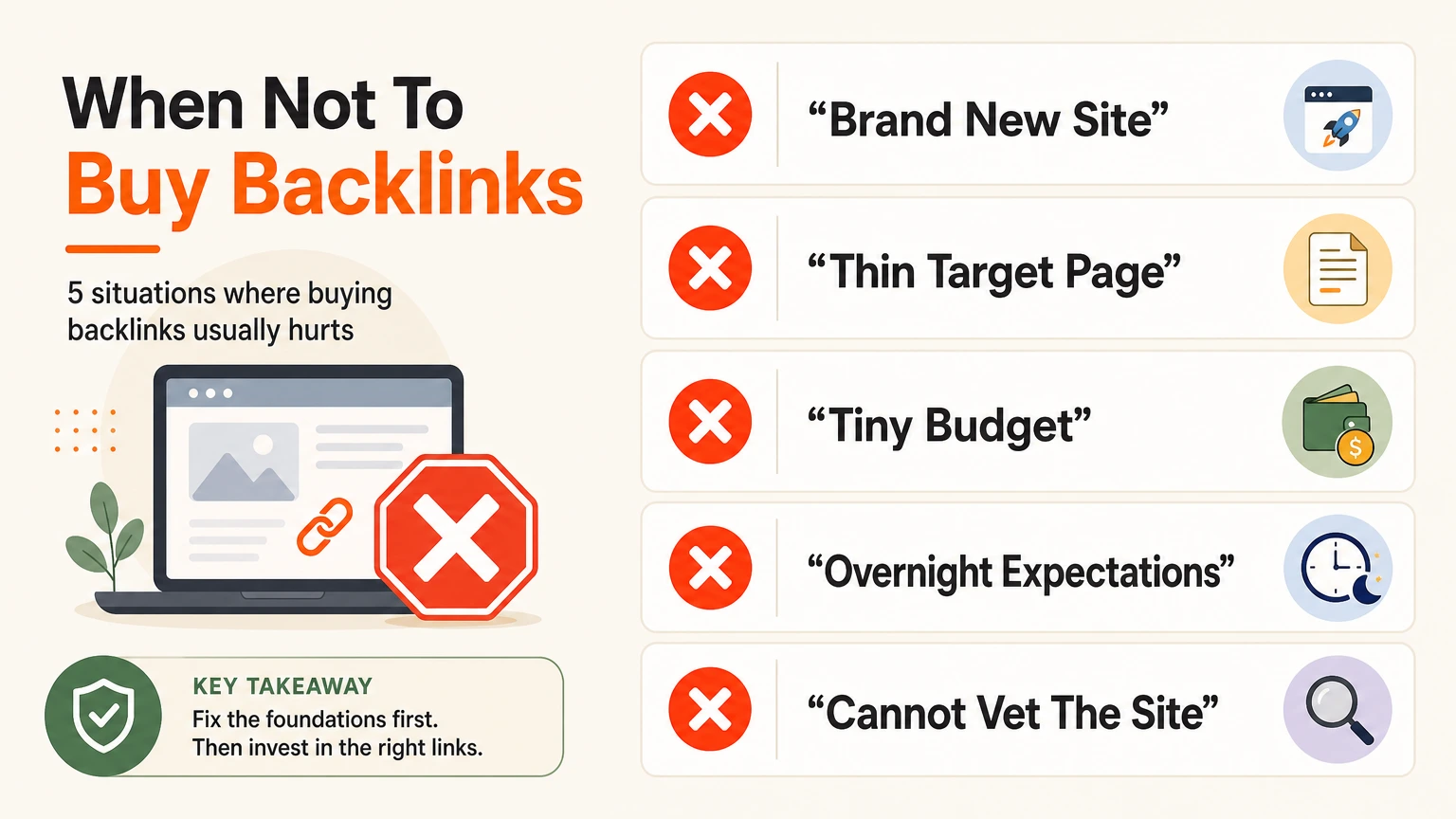
If two or more of those describe you, links are not your bottleneck yet.
The honest advice costs me a sale. If you have one budget and a young site, spend the first few hundred dollars on a genuinely useful page, not on links. Links multiply what a good page already has. They cannot create it.
A safer way to buy backlinks
Most of the risk in buying links comes from not being able to see what you are buying. That specific problem is what a vetted link marketplace is built to solve.
You see the domain, its live Domain Rating, real traffic, and spam score before you spend a dollar, instead of trusting a mystery package.
You pay per placement, you pick the site, and monitoring tells you the moment a link drops. That is verification built into the purchase rather than bolted on after.
It is not always the right answer, and I would rather you spend well than spend with us. If you need a narrative digital PR campaign built to earn national coverage, a specialist agency will beat any catalog of placements.
If you have budget but no time to choose sites, a managed service earns its fee. A marketplace is for buyers who want control and proof.
See the site before you spend a dollar
PRWiz lists 2,500+ vetted publishers with live Domain Rating, traffic, and spam score, and pay per placement from $35, so every link is a decision you can verify instead of a gamble.
Frequently asked questions
Is it legal to buy backlinks?
Will I get penalized for buying backlinks?
Is it worth it to buy backlinks?
Where can I buy backlinks safely?
How much should a good backlink cost in 2026?
Do backlinks still matter in 2026?
So here is my actual recommendation, the one I give people who are not paying me for an answer.
Buy backlinks when your page deserves to rank and you can buy relevance and real traffic to support it. Skip it when you are hoping a link will do a content job.
Safe link buying is not a trick or a loophole. It is just refusing to pay for links a real editor never would have given you.