
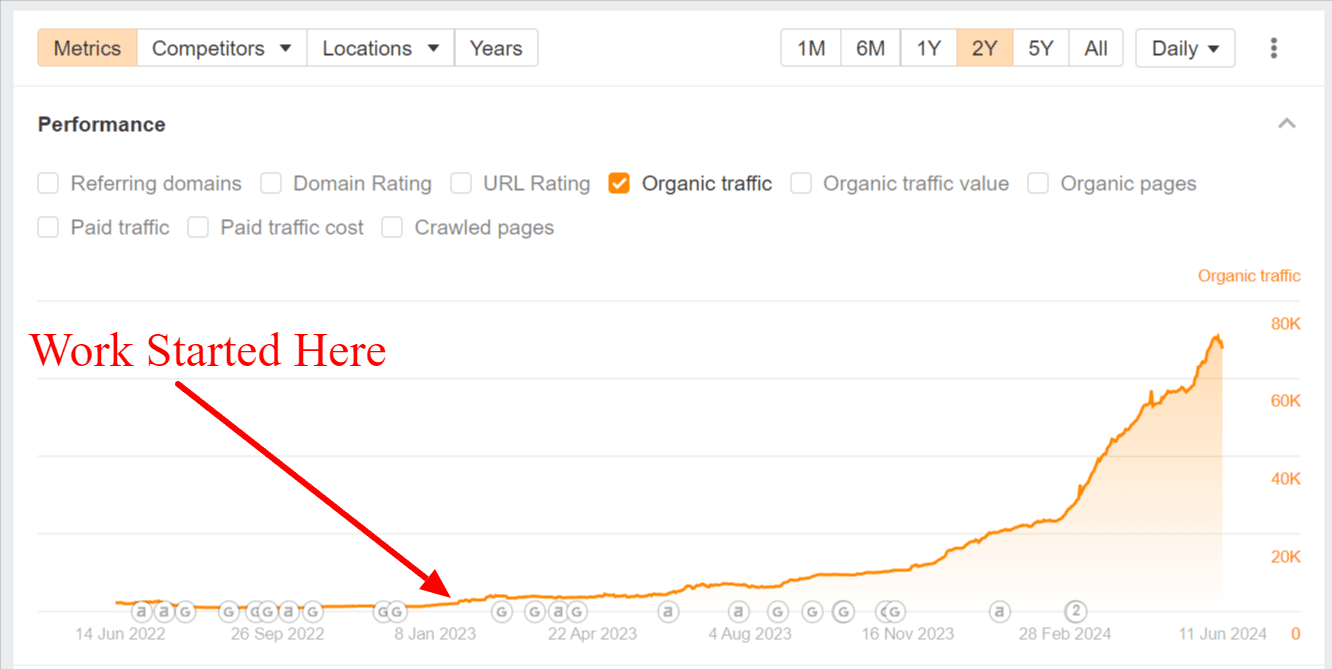
This client is a high-ticket immigration services firm — the kind of business where a single qualified lead can be worth anywhere from $10,000 to $100,000 in lifetime value. Like most B2B service firms in their space, they had been pouring budget into Google Ads to keep the pipeline full. CPCs were rising every quarter, competitors were bidding harder, and every dollar that stopped flowing to ads stopped producing leads almost immediately.
The challenge: paid-ad dependency in a high-CPC niche
Immigration is one of the most expensive verticals in paid search. Keywords for visa categories, specific country corridors, and niche legal questions routinely command CPCs in the $30–$80 range. To stay visible, the client was spending heavily — and the moment they paused the ads, the pipeline dried up.
- Around 30 organic clicks per day at the start of the engagement — effectively invisible
- Roughly 10 keywords ranking in positions #1–#3, none of them high-commercial-intent
- Heavy reliance on paid acquisition with rising CPCs eating into lead margins
- Established legal-industry competitors with decade-old domain authority
- Long, considered buyer journey — needed to build trust signals across multiple touchpoints
The goal: organic search as a scalable acquisition channel
The brief was straightforward in concept and brutal in execution: build organic search into a primary acquisition channel so the firm could reduce paid-ad spend without shrinking the pipeline. In a niche where every lead is potentially worth five or six figures, even small ranking gains compound into massive revenue impact.
Crucially, the client wasn't looking for vanity traffic. They needed to rank for the specific commercial-intent queries that drive consultations — the ones where buyers are already qualifying themselves and ready to engage a firm.
In a high-ticket niche, you don't need millions of visitors. You need to rank for the queries where buyers are already typing their credit card number.
The solution: a sequenced 5-stage playbook over 16 months
High-ticket B2B campaigns don't work on a 90-day timeline. PRWiz designed a sequenced playbook where each stage built on the last — you don't pitch journalists before you have linkable assets, and you don't run skyscraper outreach before you know what's already ranking. Below is the full sequence, in the order it ran.
Linkable asset creation
Built a portfolio of in-depth resource guides, country-specific eligibility checkers, and visa-category breakdowns. These became the magnetic content that the rest of the campaign would point at — you can't earn links to a thin page.
Foundation laid for outreachGuest posts & niche edits
Placed contextual links on legal, immigration-adjacent, and high-authority publications. Niche edits inserted into existing high-traffic pages where the client's content was a genuinely better citation than what was already there.
Authority signals start compoundingFresh blogger outreach
Cold and warm outreach to bloggers in adjacent verticals: travel blogs, expat communities, study-abroad publishers. Built relationships, not just transactions — many became repeat link sources for follow-on content.
Diversified anchor profileSkyscraper campaign
Identified the top-ranking pages for the client's most valuable queries, built objectively better resources, and ran outreach to every site linking to the originals. The “we just published something more useful than what you currently link to” pitch.
Replaced competitor citationsAdvanced strategies (entities + NLP)
Entity-based optimization aligning content with how Google's knowledge graph understands immigration topics. NLP-aware semantic enrichment so pages match the full intent behind queries, not just keyword strings. This is what unlocked the top-3 ranking surge.
Top-3 rankings explodedThe result: +6,600% traffic, $37.2K/m in value
Sixteen months in, the client has gone from ~30 daily clicks to over 2,000. Monthly organic visitors crossed 67,700. Top-3 rankings expanded from 10 to 1,114, with another 1,245 keywords reaching positions 4–10 (2,359 in top-10 total). Domain Rating climbed to 53. And critically — the page that mattered most ranked at #2 for the keyword where each lead is worth between $10K and $100K.
Ahrefs site overview — end of campaign
Source: Ahrefs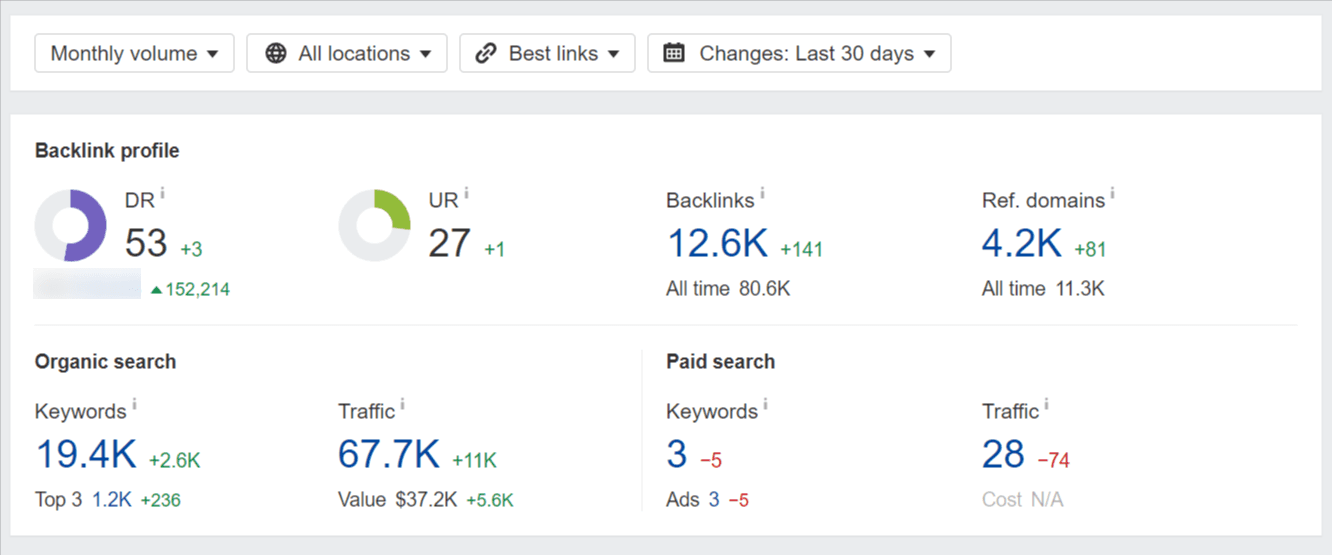
DR climbed to 53. Monthly traffic value reached $37.2K — the equivalent of what the client would have to spend on Google Ads to replicate this organic visibility.
The keyword distribution chart below tells the structural story. The orange bands — positions 1–3 and 4–10 — are where conversions happen. Watch how they expand month over month while the campaign compounds.
Keyword position distribution, full campaign
Source: Ahrefs · Organic keywords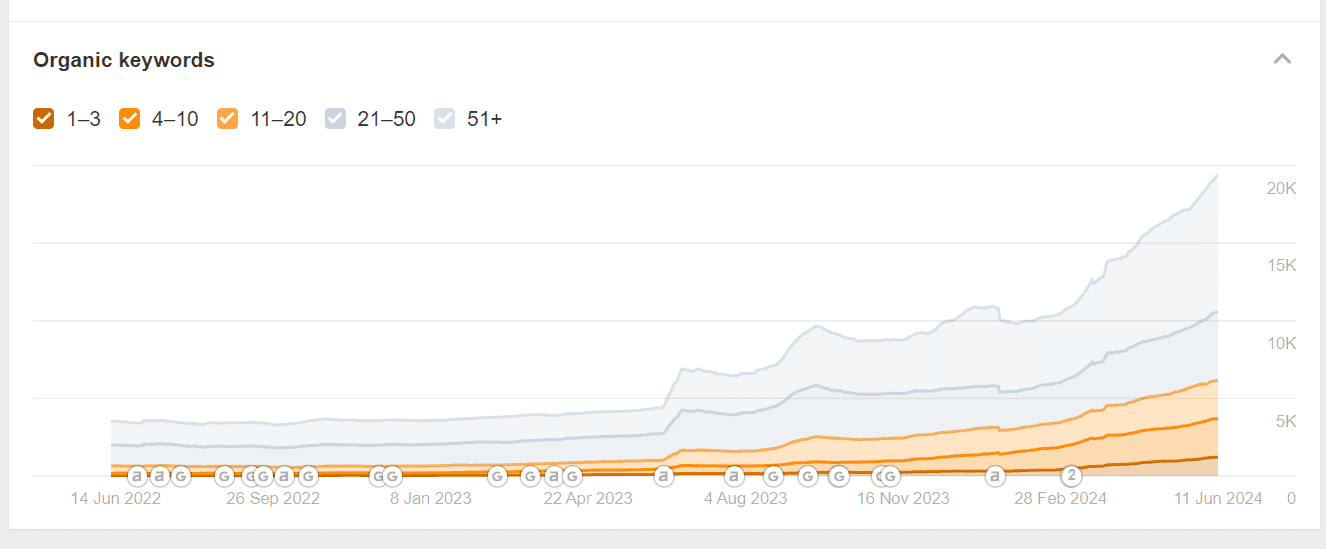
Top-3 rankings (the dark orange band) grew from ~10 to 1,114. Top-10 rankings expanded by over 11,000. This is what cutting paid-ad dependency looks like in chart form.
The math behind $37.2K/m
For a high-ticket B2B firm, the case for organic isn't traffic — it's replacement cost on paid ads. The numbers below show what this campaign is worth in the language buyers actually care about: dollars they don't have to spend on Google Ads.
What $37.2K/m organic value actually buys.
Traffic-value figures are Ahrefs' estimate of equivalent paid-search spend. Lead-value range provided by the client based on their close rates and engagement averages. Numbers are real but rounded for presentation.
That's the unlock. The campaign didn't just grow traffic — it built an asset whose carrying cost is dramatically lower than the paid-ad spend it replaces, and whose top rankings compound month over month. This engagement is still active; what was a 16-month case study at the time of writing is now a multi-year compounding system. Same playbook is available to every PRWiz client whose niche supports the timeline.